Writing in Books (or Marginalia!)

I recently read a blog post in which the writer was responding to a reading survey. The question was whether or not the blogger writes in books. The blogger wrote something along the lines of, “No.  I think it’s interesting but I don’t know what I would write“.

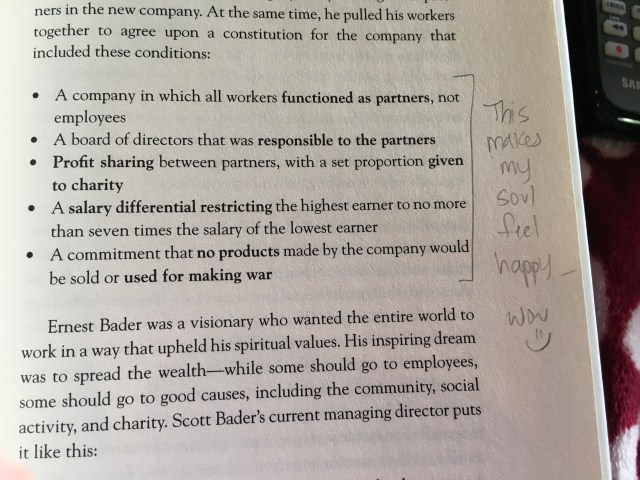
This statement has been haunting me ever since I read it. I’m baffled that someone wouldn’t know what to write in a book. As I sit, reading a professional book, marking up the margins with my thoughts and questions, I’m reflecting about marginalia.

Marginalia1

As a teacher of middle school students, I began each school year explaining how marginalia is a record of our thinking. I taught my students to be metacognitive about their thoughts as readers and writers and to pull that thinking out of their heads and onto papers for their own learning and so that their peers and I could support them. My learning came from Stephanie Harvey’s Strategies That Work and Teachers’ College Reading and Writing Workshop. I was surrounded adults learning how to teach students to be metacognitive.

As a professional, I often mark up the margins of the books I read. My marginalia includes:

  • underling lines I find important or powerful
  • adding post it notes to pages I want to return to later
  • putting stars by phrases and ideas I find worth remembering
  • writing mini summaries
  • making connections to my own work or previous texts
  • questioning ideas that are new or challenging to me

Marginalia2

I learn best by writing. While in my doctoral program, I found that if I wanted to remember something, I needed to write it down. I often wrote notes on texts themselves for my own learning. I then transferred my notes and synthesis to Evernote for future reference (i.e. quizzes, papers, my dissertation, blogging, or my work).

Marginalia3

I don’t write as much in fiction novels that I read for fun. However, the more I read e-books, the more I find myself using the highlighting feature (available in both the Nook and Kindle app). If I have a real book in my hands, I find myself folding down the corner of certain pages. My highlighting, or page folding, happens when the writing has struck me- I love vivid figurative language,  singular lines that describe a character exceptionally well, or lines that I wish I could have written. My notes in fiction texts come from me reading like a writer– always wanting to improve my own craft by studying the work of many others.

When I used to borrow books from my mother, there were ALWAYS pages folded down. She and I would have games where I would have to guess what particular word, line, or event made her fold down a page.

imgres

I even notice interesting writing habits in nonfiction texts. The text included in this post had an entire chapter with an abundance of alliteration (the use of c-words distracted me!) I couldn’t help but notice.

I hope that everyone who reads this takes a moment to think about their own marginalia, and if necessary, get rid of the guilt and give yourself permission to write in your books!

All of my marginalia included today is from Uplifting Leadership by Andy Hargreaves, Alan Boyle, and Alma Harris.  What does your marginalia look like? 

Posted in Writing | Tagged , , , , , , , , , , , , , , | 3 Comments

Most Used Phrases

A year ago I wrote a post about the most used emoticons on my phone. As I continue to reflect on how my words and actions demonstrate my beliefs, I’m thinking about the phrases we use most often.

Read any mission statement and you will see some of the following:

  • lifelong learning
  • ALL students will achieve
  • 21st Century skills
  • college and career readiness

I recently began a new job where one of the leaders continue to remind us all to focus our goal statements on each student, to help clarify our work. She is very strategic in her use of the word “each”.

The role of a leader in a school system is pretty powerful. Each word you say is heard, repeated, revised, and shared in more iterations than you can imagine. It’s similar to being around a toddler finding their voice, parroting everything you say as they learn to create their own language. This makes it especially important for us, as leaders, to be aware of the phrases we use most often.

If we say things like, “those students” or “those teachers,” we are sending a message about out belief system.

If we say things like, “our students” or “our amazing teachers,” we are sending a different message.

blog word cloud November 2015

Now it’s time to turn the mirror around for some self-reflection. The word cloud above was created from my blog’s URL- the bigger the word, the more often I have used it in my writing. I appreciate seeing reflections, students, coaching, learning, leadership, teacher, and strengths all stand out to me as I look at this cloud. Looking deeper I see time, idea, culture, Twitter, questions, and data.

As each word pops out to me, I take a moment to reflect.

What does that word say about my belief system?  

Are these words, the words I use most often, representing what I say I believe?  

At this moment in time, many of them do. One of the first blog posts I ever wrote here was called Learning, Coaching, and Leading. Those three words were an important part of my past, present, and future as an educator. They remain three important words in my vocabulary and in my vision. Reflection has become an important part of my work as a leader and I often turn to blogging for my personal reflection time. I’m glad that my written words used most often match my beliefs.

Now it’s time to pay attention to my spoken words.

What about your most used words and phrases?


Posted in Leadership | Tagged , , , , , , , , | 3 Comments

Thankful Thursday

Thanksgiving is a time to be thankful. As the year continues to fly by, and I reflect on my mindfulness and gratitude, I have a lot for which to be thankful.

  • My family, many of whom now live closer to me than ever before!
  • My friends, near and far, who make me laugh and keep me sane!
  • My nephews (via friendship) whose FaceTime calls and visits bring me so much joy!
  • My health, which is better than it was six months ago!
  • My new job, which is an exciting adventure for me!
  • My former colleagues from many previous jobs who have become friends. I look forward to brunches and happy hours with many of them (some reading here!) soon!
  • My PLN, especially on Twitter, where I am inspired and challenged and encouraged that together we can make a difference in the lives of students all over the world!
  • The ability to buy and read an unlimited supply of books for personal enjoyment and professional advancement!
  • The time to write for my own reflection and amusement!

The freedom to be who I want to be, in a profession I love, surrounded by friends and family who support me, gives me a lot to be thankful for today and always.

Posted in Reflection | Tagged , , , , , | Leave a comment

When was the last time you colored?

Mindfulness has been my focus word for the year 2015. I started this year writing an update every month about how I was developing the habit of mindfulness. It’s funny to look back now. The first half of 2015 was an incredibly stressful time for me and I needed mindfulness (and meditation and stress reduction, etc.!) desperately. Now that a lot of the stress from that time in my life is gone, I don’t feel the desperate need to remind myself to maintain my focus on mindfulness. I haven’t written an update in a number of months. Ironically, though, the habit has been built and I continue to do some of the activities that help me be more mindful on a regular basis.

One activity I discovered a few months ago was adult coloring.

IMG_3217There has been a lot of laughter about this topic in my life recently, but I do swear by the power of coloring. I have always been (regardless of my stress level) a person who says the typical, “I could never meditate because I can’t clear my mind. My brain moves faster than I talk and it never stops!”. This is true despite my attempts to listen to meditation and mindfulness apps. However, when I am coloring, everything else melts away.


IMG_3218


IMG_3219

I strongly recommend you try this out! I encourage everyone to buy a coloring book, carve out anywhere from 10-30 minutes at home, alone in a room with no distractions (I don’t even have TV or music on). I was amazed at how quickly I was able to focus on the coloring and NOTHING else, enjoying the peace and quiet, being fully mindful of what I was going.

I have never had the talent to be an artist, but coloring is easy! And it’s a fun activity, similar to playing with Play Doh, that I get to enjoy with my young nephews!

JPEG image-D8BB54B0E046-1When I grow up, I dream that I will have the coloring talent of my good friend Barb. She gifted me the amazing coloring below that she did, and I am having it framed to hang in my office. Just looking at this piece of art gives me peace of mind and makes me happy.

Barb's elephant

As the year comes to a close, I’m really reflecting on mindfulness and how helpful it was to have a focus word this year. I’m starting to contemplate what my 2016 word might be. Will you have a focus word next year?


Posted in Reflection | Tagged , , , , | 3 Comments

Over-Scaffolding

“The idea of scaffolding has historical roots in psychology and social-learning theory, which describe scaffolding as structures, tools, and assistance from more knowledgeable others that allow learners to engage in practices beyond their independent capacity.”  
     While I’m not sure where exactly I read the above quote, I have since found references to both Anghileri, 2006 and Holton & Clark, 2006, in relation to scaffolding and mathematical tasks. I wrote it down awhile ago because it rang true in my work and I’m still reflecting on it.
     How often are we scaffolding tasks that are beyond students capacity? In my experience, I find that teachers tend to over-scaffold with the best intentions. Teachers don’t want students to fail and they don’t want to be judged by students’ lack of achievement. So they build scaffolds for ALL students into all lessons. While this comes from a good place, the reality is that in these cases students rarely have time to reach their independent capacity. Unfortunately, what this does is create learned helplessness in our students. Because they are not given enough opportunities to persevere, much less fail and get back up, over-scaffolded students crumble at the sign of the slightest challenge.
     If we believe in the premise of a growth mindset, where we are all capable of increasing our intelligence and skill set with time, effort, practice, and hard work, do we need all tasks to be scaffolded?
     How does scaffolding fit in with differentiation? If our lessons are differentiated to meet a wide range of students’ needs, are scaffolds necessary? If we focus more on small group instruction, are scaffolds built into the differentiated instruction?
     I don’t have the answers to all of these questions, but I love having conversations with my smart colleagues about this topic. Scaffolds are an important instructional tool to have in our repertoire. I look forward to continuing to rethink how and when we scaffold instruction and tasks for individual students.
Posted in Reflection | Tagged , , , , , | 6 Comments

Culture of Data Use

I was in a workshop a few months ago (okay, a LONG time ago by the time I actually publish this post!), and I heard the phrase “culture of data use”. I can no longer remember the source, so I apologize in advance for my vagueness. This culture was defined by:

  • Ensuring access to data
  • Making meaning from data
  • Clarifying expectations for data use
  • Building knowledge and skills to use data
  • Leading a culture of data use

I was struck by the phrase and the entire concept of a culture of data use. In education we often suffer from DRIP- Data Rich but Information Poor. Through the NCLB era, we were forced to see our data in various color-coded charts and our schools’ names in rank order based on the data. But this mandated data identification did not, in any system in which I was a member, create a culture of effective data use.

CCC licensed work

CCC licensed work

As we now begin to analyze our most recent student achievement results (part of the SBAC here in CA), we have an opportunity to create a culture of data use. We can help students, teachers, parents, and administrators see the strengths in the data as well as the areas in which we need to grow. We can be brave and hold hard conversations about the realities of the achievement gap that still exists in too many schools. We can use the data to truly inform our instruction and to make a different in student learning moving forward.

There is much knowledge we need in order to use the new data. We need to understand the new proficiency levels, the claims, and how the standards are assessed in an integrated fashion. We need to remember that these data are one point in time, one measure of a year of teaching of learning, one element in our data culture. We must also recognize that if we don’t teach to the depth of knowledge called for in our state standards, our kids won’t have the opportunity to achieve the highest levels of achievement.

How is your school or district creating a culture of data use?

Posted in Leadership | Tagged , , , , , , | Leave a comment

Strength-Based Coaching

The strength-based movement has been around for quite a while. It was at least ten years ago when I read the first Strength Finder book (after my principal at the time gave it to me as a gift). Since then, I have taken the strength finder quiz as part of a staff book study when I was a principal, with my team of Coordinators, and in my doctoral program. I was even prompted to go through a strength-based quiz on the Happify app recently! Every time I take the quiz or discuss strengths with colleagues, I am reminded of the value of starting from a positive place.

How can this support coaching? What if every coach entered into each conversation with a teacher from the teacher’s strengths? What if teachers knew that coaches (and administrators for that matter!) wanted to discuss their strengths, their positive attributes, the ways in which they support student learning? We all got into this profession because we care of students and have a love of learning. How might our conversations shift if we remind each other of this in kind, positive ways?

CCC licensed work

CCC licensed work

Many leadership classes study the SWOT Analysis (pictured above), to determine the strength, weaknesses, opportunities, and threats related to a systematic change, initiative, or decision that may impact a school or district. What if we considered elements of this when coaching teachers? What if coaches helped teachers identify their strengths and the opportunities available to enhance their teaching on behalf of the students we serve?  How might strength-based coaching enhance your impact? I believe that coaching should be grounded in the teacher’s desire to grow as a professional, starting from his or her strengths.

A coach’s role, especially when building a new relationship, is to help a teacher articulate his or her own strengths. This conversation can then move into a deeper discussion about the teacher’s professional goals which can lead to coaching work. Coaching with beliefs in teachers’ abilities and high expectations for everyone can transform our schools.

What strengths do the teachers in your school or district have?

How do you celebrate and coach from a place of strengths?

Posted in Coaching | Tagged , , , , | 6 Comments

The Writing Process for a Blog Writer

I’ve been doing a lot of reading of professional literature on the teaching of writing, the writing workshop, and the writing standards for students. As the idea of the writing process comes up over and over again, I took pause to reflect on my own writing process when creating a blog post.

First, I always have an Evernote file called “blog ideas”. Whenever a random thought comes to me, I jot it down in that file. This idea list includes quotes, other blogs as references, random thoughts, and even a paragraph of writing on one topic. If I have time to blog and don’t have a particular idea, I open up that file and might select one of my random ideas to turn into a blog post. This part of my process has evolved from my old writer’s notebooks and my clothesline of brainstorming ideas!idea

Once I have an idea (new or old!), I usually write a quick draft. Lucy Calkins calls this a “flash draft” in her book, A Guide to the Common Core Writing Workshop. My first draft is usually choppy, as I am simply putting words to paper (via keyboard!) to get the idea out. I will often leave a first draft saved for awhile before returning to it to polish with revision and editing.

Part of my revision process when blogging is to enhance my ideas with additional information. I will often add more description or force myself to give more details that paint a richer picture. Sometimes I use mentor texts to support me in this stage of the process. I love to see how others craft blog posts on certain topics or for certain effect.

Around this time I realize that I need to add graphics or pictures to my post to break up all the words. I tend to add visuals and edit for spelling and grammar at the same time. One of my favorite features of WordPress is the “Preview” feature. In preview you can see what a blog post will look like on your blog. In this view, I can check for spelling and grammar while reviewing the formatting.

I am notoriously bad at rereading my own writing, so this is a step I sometimes skip before hitting publish on a blog post. I have one particular savvy reader who is sure to email me if he spots any obvious mistakes! 😉

The last step in my writing process is to check back for feedback from readers (via comments, twitter, or emails). I love interacting with my audience and find that an especially thrilling part of blogging. I hope that our students experience this thrill with their writing as well!

What is your writing process?

Posted in Writing | Tagged , , , , , | 1 Comment

Why I Write

Today is a day of writing! NCTE,  The National Writing Project, and the New York Times Learning Network have partnered with Teaching Channel to share this campaign. Students and educators around the country are asked to reflect about why they write.

I write to:

  • reflect
  • process my thoughts
  • share ideas with a global community
  • express my creativity
  • relax and have fun!
CCC licensed work by USFWSmidwest

CCC licensed work by USFWSmidwest

As a child I filled up notebook after notebook with the stories I created for my own amusement. High school and college stymied my love of writing (and reading) for quite a while. However, as a younger teacher, I had the opportunity to attend the Teacher’s College Reading and Writing Project summer institute for writing (and reading!). It was there, in the hot, sticky classrooms in New York City that July, where I rekindled my love of writing and I haven’t looked back since!

TCRWP

I became a much better, stronger, more supportive teacher of writers (because we teach the writers, not the writing!), after this experience. The more I wrote, the better able I was to talk to my students about writing and their goals as writers. I believe that all educators are readers and writers with the power to model those skills for students in any content area.

As an educator I write to inform, to persuade, to entice, to support, and to coach. As a professional I also write to tell a story [about our work]. Not a day goes by that I don’t write, whether it takes the form of an email, a tweet, a blog post, a website update, a newsletter article, or a board agenda item. Writing is a powerful form of communication. Writing is also a skill that our students need to develop in order to be successful in so many future paths. More importantly, I fervently hope that our students develop a love of writing now that stays with them forever!

CCC licensed work by pixaby

CCC licensed work by pixaby


Why do you write? 

Posted in Writing | Tagged , , , , | 3 Comments

The Art of Questioning

One of the most critical skills a coach can learn and practice is the art of questioning. And it truly is an art when it comes to a teacher-coach relationship. There are all sorts of questions a coach can ask. Here is a list of some, not all question types:

  • Factual questions- details about standards, lesson planning, students, etc.
    • What standard will you focus on for this lesson?
    • How many of your students need a scaffold to be successful during this lesson?
  • Yes/No questions- simple questions that allow a teacher to feel comfortable about the topic at hand by first starting with easy questions to answer
    • Have you read this text before?
    • Do you know the Lexile level of this text?
    • Do you have the manipulatives you need for this math lesson?

question marks

  • Clarifying questions- important follow-up questions to ensure the teacher and the coach have a common understanding of the elements of instruction and learning
    • Can you tell me more about the “struggles” you observed your students having during the lesson?
    • What “student behaviors” bothered you?
    • What do you mean by “engagement” during a lesson?
  • Reflective questions- open-ended questions created to help the teacher reflect on his/her practice
    • How do you feel about the lesson?
    • Why you do think the students were successful?
  • Wondering statements- not technically a question, but a statement that is shared in the hopes that a teacher can reflect on a particular topic
    • I wonder what might happen if we had the students talk to their partners before we ask them to write.
    • What do you think might happen if we don’t provide that scaffold?
  • Loaded invitations – I’m borrowing this concept from Katie Wood Ray and her book Study Driven: A Framework for Planning Units of Study in the Writing Workshop, where she borrowed the idea from Peter Johnston. A loaded invitation presupposes that someone is thinking about a particular topic.
    • What are you thinking about student engagement during your Read Alouds?
    • What are you thinking about providing more independence for students?

questions2

Questioning becomes an art in the heat of the moment. A coach must be skilled enough to know which type of question will work in any particular coaching conversation, and be able to think on the fly. I always encourage coaches to write down some sample questions or question stems for themselves before going into any coaching conversation, especially if they know themselves well enough to know that this isn’t yet an area of strength for them.

The best way to improve your questioning skills is to practice. This involves a lot of listening! While role-playing makes many people (especially introverts!) uncomfortable, this can be an important tool to support coaches in their questioning skills.

Thanks to #educoach for the blogging challenge/inspiration this month! 


Previous posts about questioning:

Facilitating Learning by Questioning

Questioning

Reflective Questions


Posted in Coaching | Tagged , , , , , | 8 Comments