What I’m Reading (Volume 4)

I love reading. I started these updates at the beginning of my doctoral journey, mostly to ease my personal guilt about having no time to read fiction or read for fun. Now my typical reading has expanded in so many ways.

Here is a round up of what I’ve been reading lately:

  • Twitter: I just discovered two hashtags that I am loving: #titletalk and #growthmindset. No matter the time of day, I can find wisdom and inspiration from colleagues near and far on these hashtags! Plus I FINALLY got myself onto Tweetdeck, which makes participating in chats SO much easier! Who knew it was a google app on Chrome?!
  • Collective Bargaining Agreements (aka contracts between unions and school districts): For my current HR doctoral class, we have to do an in-depth analysis of both the Certificated and Classified CBAs of our district. If you have never read an entire contract from front to back, it’s fascinating reading! If you are a site or district leader, it is necessary reading. I don’t recommend you ever go into a meeting with a teacher who knows the contract better than you.
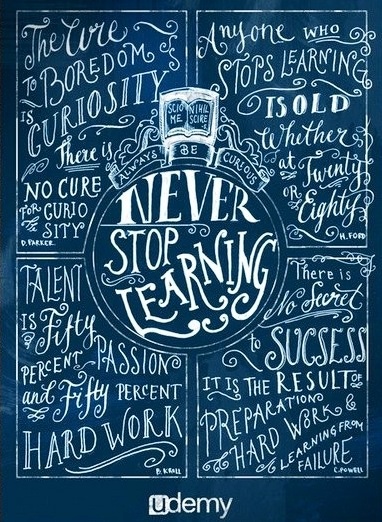
  • Pinterest: I am a Pinterest fanatic! I love the pictures and quotes and inspiration I can find just in a few moments of  viewing. One of my favorite boards to add to lately is a board simply called “learning”.

never stop learning

  • The Boy on the Porch by Sharon Creech: After seeing someone tweet about this on #titletalk, I knew I wanted to read it. I love everything Creech writes and Memorial Day weekend was the perfect time for a quick, YA novel. This is a sweet story told in very short chapters that often include very long, detailed, elaborate sentences. When I finished it, I was happy and yet I wanted more, which is a sign of a great story to me!
  • Flora and Ulysses: The Illuminated Adventures by Kate Dicamillo: Another author whose work I love, this book won the 2014 Newbery Medal and caught my eye as I was searching for another young book to enjoy. My cape-wearing friend Barb will love the superhero idea within this fun story.

What are you reading these days?  Any recommendations?


Posted in Doctoral Journey, Learning | Tagged , , , , , , , , | 2 Comments

When Worlds Collide

This summer I am taking two non Curriculum and Instruction (C & I) courses in my doctoral program. We are studying Human Resources and School Law and Finance. When I took similar classes in my Master’s program, I had a focused interested: learn the basics of what a principal needs to know to run a school. Now that I’m in a different position in my career and my studies, with new aspirations for my future, I have a very different focus. I want to learn how to bring these worlds together.

Most districts are split up into some version of three areas: C & I, HR, and Business. Working at the district level, I now know how important it is to have your HR and your Business departments work in collaboration with your Curriculum department. Curriculum leaders often feel like the stars of the world- making key decisions about what and how student learning will occur, improve, and change. But if we do not have the support of our HR department, to ensure we have high quality teachers and leaders in our schools, we cannot be as successful. In addition, without the financial support from the Business department, curricular goals cannot be met.

I believe that a Superintendent plays a critical role in ensuring that her (or his) Cabinet members work together in conjunction, all in support of a common vision centered on equitable educational success for all students.

I’m looking forward to a summer of learning more about leadership in HR and Law/Finance.

Scales of balance

  • Have you ever considered a leadership role in HR or Business?
  • How are these departments connected and supportive of one another in your school district?
  • How important is it for a Superintendent to have knowledge and experience in all of these areas?
Posted in Doctoral Journey, Leadership | Tagged , , , , , , , | 4 Comments

Things I’m Loving Friday, Volume 5

I enjoy sharing a quick list of the learning and leading (and some fun) “things” that are capturing my attention, sparking my curiosity, or pushing my thinking. I love reading Barb’s versions as well! I would love it if you would play along by adding the things you are loving this week in the comments section.

This week, here are the things I am loving:

Firefighters: I live in Southern California, and though I was not directly affected by all of the wildfires that broke out last week, they still impacted me. The pictures were frightening, the idea of arsonsists disheartening, but the bravery of firefighters… outstanding! During 100+degree heat, with 9 fires raging across our county, firefighters from all over came to fight these fires and save homes and lives. I know I speak for so many when I say THANK YOU!


Twitter: I have spoken of my love of Twitter before. This week, I love that Twitter helped me get immediate information about the SD wildfires quicker than any other outlet. I also love that a Twitter chat with my colleagues sparked some recent tweets by them. In addition, I continue to be pleasantly surprised by the connections I make through Twitter. Whether I’m tweeting about blogging or my dissertation or social justice, I can find a colleague near or far to expand my thinking in new ways. I’m still trying to convince others (colleagues and professors, most recently) to find their own professional value in Twitter.

Feedly: I was very sad when Google took away the Reader feature. I thought my favorite daily blog reading would disappear or get lost in the shuffle. Once I made the transition to Feedly, my sadness disappeared. It’s been a long time, but I still love how easy Feedly is to use.

  • What are you loving lately?
  • What blogs are in your daily must read lists?

Previous Things I’m Loving Friday posts:

Posted in Writing | Tagged , , , , , , , | 8 Comments

[Abecedary of Reflection] Slow Down

S: Slow Down

As I get closer to the end of the alphabet and this abecedary journey, I am reminding myself of the power and importance of slowing down. While I had a list of possible “s” words ready for this post awhile ago (share, strength, success, systems), the idea of slowing down is most important to me at this moment of reflection.

There is never enough time. We all have the same 60 minutes in an hour, 24 hours in a day, and 7 days in a week.  What we choose to do within those minutes, hours, and days is what counts in the long run. And sometimes the best thing I can do with my time is slow down and reflect on where I’ve been and where I want to go next.

Bryce Canyon, UT

On a recent hiking trip to Zion and Bryce Canyon in Utah (with two of my loyal blog readers & relatives!), I had the opportunity to slow down. We were hiking every day (and reaching 25,000 steps a day!) and it felt like we were moving all the time. However, out in nature, without the daily stresses of work, school, and life, my mind was able to slow down. It is rare that my mind’s warp speed (similar to my speech speed!) decelerates. Not only was I able to recognize this rare feeling, but I was able to reflect on the benefits.

  • My back pain was surprisingly non-existent throughout our entire trip.
  • I slept better than usual (I must attribute this more to the physical work I was doing than the mental reflections!).
  • My daily allergy cough was not its usual bother.
  • I had an amazing time, in both the beautiful weather of Zion and the snow, hail, and 32 degree weather that surprised us in Bryce!

Now if only I could build in vacations more often… 😉  For now, I will add reminders in my calendar to “slow down” as I do to “reflect”.

Zion- Top of Angel's Landing

Reflective questions to consider:

  • How do you slow down?
  • What do you notice about yourself when you are able to slow down?
  • How do you quiet your mind to help with deeper reflection?

Abecedary of Reflection

Posted in reflection | Tagged , , , , , | 7 Comments

[Mentor Text Monday] Tweets

I haven’t posted a Mentor Text post in a while, due to most of my reading being dense research articles. I remind my readers that research articles are not the type of writing you want students or teachers, or most normal adults, to use as models of great, intriguing writing. However, I have also been reading a lot of tweets lately.

A study of how tweets are written would be beneficial for anyone new to twitter. 14o characters does not provide you a lot of space in which to share a powerful message. But there are ways it can be done.

Take this tweet for example:

This person, who I had never heard of before she was retweeted by someone I follow, has a show on the OWN network called “Fix My Life”. Notice how she turned her show title into a hashtag (that is a phrase following the # sign) at the end of her tweet. Her use of capitalization calls attention to her point. You can also tell that she was running out of space because there are no excess spaces after punctuation!

Here is another tweet:

Love how this promotes a GROWTH MINDSET! “This is helpful” via @RCNowellVP #geniushour #edchat #edreform #sd36learn pic.twitter.com/aCx2lfrJGZ

What I like about this tweet is how much information is crammed into such a tiny space. First there is the author’s opinion, including CAPS for emphasis (and FYI, growth mindset was a trigger for me to read this one closely!). Then he gives credit to @RCNowellVP who obviously shared the original picture (which didn’t show up when I embedded the tweet above, but which is seen when you are viewing this directly on twitter). Next the author adds in four hashtags to clue in others he feels might find this information useful. Finally, the picture is attached for all to see.

And here is a more personal tweet in response to one of my own:

@DirectorAmy 🙂 Made my day! Happy discussing to all!

Elena Aguilar is the author of The Art of Coaching, a book I have been using as a professional resource with the coaches with whom I work. Whenever we have a twitter chat about our reading, I reference her at least once. It is still a thrill when she responds. But to read her genuine, authentic response above, with no ego or agenda, made my day right back. 😉

Tweets can include:

  • words
  • phrases
  • hashtags
  • pictures
  • graphics
  • links to blogs, articles, references, sources
  • lots of meaning
  • lots of fluff

What kinds of tweets do you enjoy reading?  Please find me on Twitter (@AmyLIllingworth) so we can discuss mentor tweets more!

Does your classroom, school, or district have a Twitter account?

How do you teach students and teachers about valuable Twitter messages?

Posted in Mentor Text Monday | Tagged , , , , , , , , , | 3 Comments

[Abecedary of Reflection] Resiliency

R: Resiliency

CCC licensed work on flickr by Alan Levine

CCC licensed work on flickr by Alan Levine

Leadership is often about resiliency… standing up in the face of adversity, getting back up after being pushed down, planting the seeds of hope in what appears to be a field of rocks or concrete or unturned stones.

To me, resiliency is not something that can be taught, but is something that must be learned, through experience. As a new principal, I often struggled with not only the big challenges, but also the day-to-day frustrations. Being an elementary principal can be isolating and lonely. Over time I developed the leadership skills to handle the ups and downs. I also developed my own resiliency.

Was it always easy  Absolutely not!

Am I a stronger leader today because of the adversity I have overcome  Absolutely!

I hope that today we develop resiliency in our leaders, our teachers, and our students. The first Mathematical Practice called out in the Common Core State Standards asks us to help our students learn how to “Make sense of problems and persevere in solving them.” Wouldn’t it be great if all of our students, teachers, and leaders had this skill? It is not easy, and it is not taught in one lesson. But it is valuable and necessary as we move forward in a global society where the answers won’t always be handed to us by an “expert”.

Reflective questions to consider:

  • How do you develop resiliency in others?
  • What challenges have you overcome?

Abecedary of Reflection

Posted in reflection | Tagged , , , , | 2 Comments

THE Debate

Common Core.  Common Core State Standards. CCSS.

In some circles, these are dreaded words  I have read the rants, heard many complaints, held my tongue, and waited. I have also responded when I felt it appropriate. I have come to a place now that I feel confident in sharing my own personal opinions about Common Core, especially in light of all the misinformed statements I have seen come up recently.

To me:

  • The CCSS are a set of rigorous, academic standards.
  • The CCSS are not a test.
  • The CCSS will be assessed by a variety of tests (SBAC and PAARC are the two main consortiums). Liking/hating the standards and the test are two different things and they should be separated.

The Common Core State Standards have potential:

  • To be successful IF implemented by a system that designed a clear, focused plan for implementation that includes communication, support, and TIME for teachers to learn and plan with understanding!
  • To be completely unsuccessful if implemented without all of the above (as I have sadly seen/heard of happening in districts across the country).
  • To help us close the achievement gap and provided more equity in systems where students of color and students from poverty have consistently been left behind.
  • To open the doors for nation-wide discussions about our public educational system.
  • To enhance national collaboration among educators.

ALL of our children deserve to leave their K-12 education ready for either college or a career of their choosing. All of our children deserve the opportunity to read a variety of texts, think critically, write analytically, and speak eloquently. I know many adults who still need practice in some of these areas.

When I think about social justice, or the reasons that we in California have the Williams Legislation, I think of all of the students who have been under-served by programs with no standards, with poorly implemented standards, or with low expectations for certain student groups. While the Common Core State Standards are by no means perfect, nor the magic bullet we need to fix the problems we have within the education system, they give us a new, common ground from which to start.

My colleague Barb shared her own opinion about the recent debates in this eloquent blog that says it much better than I ever could!

What are your thoughts? I’d love to continue the discussion with educators who are experiencing CCSS roll-outs.

Posted in Leadership | Tagged , , , , , , | 4 Comments

[Abecedary of Reflection] Quotes

Q: Quotes

I just said to a friend the other day, “I could sit and read quotes all day!” One way that I like to push my own thinking is to reflect about quotes I read from other leaders and learners.

There are only two ways of spreading light- to be the candle or mirror that reflects it.” ~Edith Wharton

I enjoy this quote because of the meaning of reflection via a mirror as well as via what we put out into the world for others to see. I think leaders need to be be both- sometimes the candle shining the light for others to find their way and sometimes the mirror highlighting the light of others.

Happiness depends upon ourselves” ~ Aristotle

This is so true, but in the heat of a stressful moment I have to stop and remind myself of this. I am in control of my reaction to the people, events, challenges, and successes before me. I have the ability to see the good in people and situations. I can choose to be happy despite the unhappiness of others. I do not have to let others’ negativity affect me. This was a hard lesson for me to learn as a young leader, but with time and experience and relationships built on trust, I am in a better place with this idea.

CCC licensed work by www.pittillapr.co.uk

CCC licensed work by http://www.pittillapr.co.uk

What I like most about change is that it’s a synonym for ‘hope’.  If you are taking a risk, what you are really saying is, ‘I believe in tomorrow and I will be part of it.‘” ~ Linda Ellerbee

In challenging situations, you can hear many peoples interpretations of synonyms for hope. I like this perspective because it comes from such a positive place. As an organization is embarking on a large initiative that means big changes (i.e. Common Core implementation!), how amazing would it be if all stakeholders jumped on board and said, “I believe in tomorrow and I will be part of it”?  What a powerful, collective statement that could be.

If the person who talks the most learns the most, who is doing the most learning in your classroom [or workshop]?” ~ Anonymous

I can still remember the first time I heard this quote. I was a part-time teacher and a part-time Literacy Coach. The meaning of these words had an instant impact on me both as a teacher and a professional developer. I became acutely aware of how much I was talking instead of my students or participants. I made a dedicated effort to find a better balance in all those situations from then on. I am reminded of this when I visit classrooms and see teachers in our district working hard to find a 50/50 balance between teacher and student talk. I am also reminded of this when I attend certain workshops where the presenter spend the entire time (be it one hour or six!) talking AT us, instead of interacting WITH us.

quote jar

Reflective questions to consider:

  • What is your favorite quote?
  • How do you use quotes to inspire or reflect?

Abecedary of Reflection

Posted in reflection | Tagged , , , , , , , , | 2 Comments

Progress Monitoring

I apologize in advance for yet another gym/yoga-related analogy, but this is my current life! During a recent workout session my trainer exclaimed, “I cannot believe how flexible you are!” He asked me how long it took for me to be able to do a certain stretch. At first, I didn’t have a clue how to answer. My response became something about my regular yoga practice over the last six months helping improve my flexibility tremendously.

This made me think about the importance of progress monitoring. My trainer monitors my progress through my weight, body fat percentage, and ability to do more- lift more, move faster, etc. He plans out how often he will measure my progress and keeps track of it in my file. Without this monitoring, I would have spent way too much time stressing out about numbers on the scale in isolation, instead of being able to see the big picture of my health improvements.

Progress monitoring in the classroom is equally important. Knowing what we want our students to learn, and then checking if they’ve learned it is crucial. This information also drives differentiated instruction and intervention supports.

But what does progress monitoring look like when you are a leader, working with adults? As a coach, supporting improved instruction? Or a principal or district leader, ensuring quality teaching and learning for all students?  How do you monitor progress within your leadership team?  How do you support leaders in setting goals and monitoring their own progress?


CCC licensed work by pixabay.com

CCC licensed work by pixabay.com

Posted in Learning | Tagged , , , , , , | Leave a comment

Taking a Comprehensive Approach to Common Core Roll Out

I wrote this over a year ago and it was finally published by the Phi Delta Kappan Educational journal in their online Common Core support journal

I’ve just entered a 5th grade classroom with two site-based Academic Coaches. We are doing a version of instructional rounds as a team—discussing instructional practices aligned to the Common Core State Standards (CCSS). We’ve been here before, we’ve been working together to support our district implementation of the English-Language Arts (ELA) CCSS. The teacher is open and welcoming, the coaches are eager to coach and to be coached; in fact, the coaches invited me to visit today. The teacher’s lesson is focused on the fifth grade reading standard six for Informational Text — Analyze multiple accounts of the same event or topic, noting important similarities and differences in the point of view they represent.  As the lesson progresses, I see that the direction the teacher is headed is not aligned to the standard and I coach the coaches into this same realization. As we discuss how to provide support in this teachable moment, the teacher begins to direct the students into practice that will further their misunderstanding.  I look to the coaches—they share my understanding that this is a pivotal opportunity to support the instruction of this teacher. They know her well, and with that knowledge they encourage me to offer immediate side-by-side modeling.  I am able to talk to the teacher and model a quick direct instruction example with the students to redirect the focus to align with the standards.

CCC licensed work by commons.wikimedia.org

CCC licensed work by commons.wikimedia.org

As a district, we created a system-wide support for our Common Core English-Language Arts implementation through professional development, coaching, and support.  Every leader and coach in our district participated in over 40 hours of professional development during the 2012-2013 school year to prepare for our CCSS ELA roll out.  We front-loaded our leadership staff with learning and then supported them through the facilitation of that learning at their sites.  Each teacher participated in at least eight hours of professional development over the summer.  During the first year of full implementation, 2013-2014, we continued to provide professional development at the district level for leaders and coaches, with site-based support as needed.  Our board goals were rewritten to focus on CCSS alignment within classrooms, as opposed to previous goals around Adequate Yearly Progress (AYP) measures.  This system was designed to support the instructional shifts necessary to meet the expectations of the Common Core.

As a district administrator, I work closely with our instructional coaches.  We fund at least one coach position as each school to support teaching and learning.  Our coaches receive professional development along with their principals through our leadership work.  In addition, we meet monthly for our own professional learning as coaches, participating in book studies, professional readings, twitter chats, blog writing, and content learning.   We spend much of our time discussing research-based instructional strategies and the ways to support teachers to incorporate these strategies into their daily practice.

Guiding my work each day is the belief that “To be productive and to accomplish organizational goals, schools need cohesive and cooperative relationships.  Trust is essential to fostering these relationships” (Tschannen-Moran, 2004, p.16).  I visit schools to work directly with our coaches.  During site visits we observe classroom instruction, discuss instructional strengths, and determine coaching messages that will enhance or improve instructional practices.  It is through multiple site visits a year, personal conversations with coaches, and individual feedback to coaches and teachers that I developed collaborative, trusting relationships that allow me to support instructional shifts through on-the-spot coaching.

Instruction does not change overnight.  Fully aligned CCSS instruction does not happen by accident.  Intentional professional development with on-going coaching and support are critical.  Research shows that on average it takes “20 separate instances of practice for a teacher to master a new skill, and this number may increase if a skill is exceptionally complex,” (Gulamhussein, 2013).  The skills required for teachers to align their instruction to the complex expectations of the Common Core State Standards demand multiple practice opportunities for teachers and coaches.  Coaching to support CCSS-aligned instruction requires in-depth knowledge of the standards as well as the instructional shifts necessary to meet the expectations of the standards.

Let’s return to the classroom example I mentioned earlier.   The Common Core State Standards call for major shifts to our instructional practices, with a greater focus on text complexity, deeper levels of student cognition, and more analytical reading and writing.  The College and Career Readiness Anchor Standard for Reading Standard Six calls for students to, “Assess how point of view or purpose shapes the content and style of a text” (Core Standards, 2014).  There are many misconceptions about this standard.  Teachers familiar with the idea of first person versus third person narration are teaching a limited version of their grade level’s expectation.  As students progress out of the primary grades, this standard, especially in Informational Texts, requires students to understand point of view in relation to the author’s perspective, which is a new and unfamiliar concept to many teachers.

The 5th grade classroom we entered that day, was struggling with this concept. The teacher, while dedicated and embracing new learning, was still emerging in her understanding of this standard. She was directing her class to identify the author’s point of view, but students’ interpreted that direction to mean “state the opinion of the author”.  The students were, at first, using a text that was not complex enough to do the thinking or analysis required of the standard.  As we coached the teacher, she provided her students with a much richer, more complex text.  I modeled, for the teacher and the students, a connection between “point of view” and “perspective”, asking the students to take a moment to read the blurb about the author (who happened to be a holistic doctor) before reading the article.  The students had been studying the use, or over-use, of personal devices.  I asked the students to think for a moment about what point of view, or perspective, this particular author might bring to the topic.  This slight shift reframed the purpose of the standard for the teacher and gave the students a more authentic purpose for reading the article.

It was only through direct contact with the teacher in the act of teaching that we were able to positively affect this instructional shift. While professional development opportunities, supported planning time, and ongoing site-level support provided the structure for this lesson, it was the one-on-one teachable moment that truly turned the tide. From there, the teacher and the coaches were able to share their new learning with the entire 5th grade team during their PLC later that same day, affecting a larger instructional shift at this site. In fact, I received separate emails from both of the academic coaches as well as the teacher after this visit. In each email, my colleagues shared their new understandings of the standard in question as well as the instructional shifts necessary to meet the standard.

Fisher, Frey, and Uline (2013) define five shifts in literacy instruction with full alignment to CCSS:

  1. Focus on reading and writing to inform, persuade, and convey experiences
  2. Focus on increasing text complexity
  3. Focus on speaking and listening
  4. Focus on text-based evidence for argumentation
  5. Focus on academic vocabulary and language

In addition, the authors highlight the critical importance of PLCs as teachers begin to examine their current practices and prepare for the instructional shifts necessary to meet the demands of the Common Core State Standards. In our district, while we created ELA Units of Study at the district level (with teacher teams), we left the day-to-day planning for instruction at the site level.  The process we introduced in our professional development highlighted the importance of PLCs to ensure that no teacher was working in isolation and that, as a team, teachers were unpacking the new standards.  The more we know about the expectations of the CCSS, the better we are able to align our instruction to both the standards and our students’ needs.

The job of school leaders, and every day practitioners, is to translate these theories into meaningful practice in the classroom.  On-going, job-embedded professional development, through coaching, instructional rounds, lesson study, and high-functioning PLCs, is the structure we have created to support our district on this journey.  As I visit classrooms, coaching teachers and coaches, I am reminded that this is a journey we are all on together.


References

Core Standards (2014).  Retrieved on March 28, 2014 from             http://www.corestandards.org/

Fisher, D., Frey, N., and Uline, C.L. (2013).  Common Core English language Arts in a

            PLC at work: Leader’s Guide.  Bloomington, IN: Solution Tree Press.

Gulamhussein, A. (2013).  Effective professional development in the era of high stakes

accountability. National School Board Association: Center for Public Education.

Tschannen-Moran, M. (2004).  Trust Matters: Leadership for Successful Schools.  San

Francisco: Jossey-Bass.           

Posted in Leadership, Learning | Tagged , , , , , , | 4 Comments