ASCD by the tweets

It’s been a week since I attended the ASCD national conference in Los Angeles. I haven’t had a spare moment to write any deep reflections on what I heard, so I thought I would recap some of my favorite moments through the tweets I sent or favorited. If you scroll through the #ASCD14 hashtag you can see the great thoughts and ideas shared by the 9,000 participants throughout the four-day weekend. Here are some that stood out to me:

  • Key principle in RTSI: equality is not equity
  • DOK is not about the action, it’s about what you do with the knowledge
  • If you ask a question and can find the answer on Google, it is probably not an essential question.
  • The thought of attending the #ascd14 tweet up makes the introvert side of my ambivert self quake with terror.
  • Talking about racism is not about indicting anyone, but acknowledging it so we can close the gap.
  • Wealth accounts for 15% of the achievement gap
  • No one will change behavior unless they are uncomfortable
  • @danmcdowell Think of each student’s Google folder as their “backpack”, it’s where all their work goes.

From Daniel Pink’s key-note:

  • Ambiverts – people who are somewhat introverted and somewhat extroverted @DanielPink
  • Cheapest performance enhancer: explain WHY!

From Eric Jensen’s session:

  • Chronic stress significantly affects people in poverty
  • Increasing control decreases stress… How much control do we give our students?

From Sir Ken Robinson’s key-note:

  • We have a 30% non-graduation rate. I hesitate to say they failed the system but more the system failed them.
  • Great teachers are also learners! Need to pass on confidence in learning.

From Dr. Russell Quaglia’s key-note:

  • We are all students’ heroes… Only choice is whether you are a good or bad hero.
  • The longer kids are in school the less they understand why they are there. That is on us.
  • Get rid of the expectation gap

From Dr. Tony Wagner’s session:

  • The world cares about not what you know, but what you can do with what you know
  • Preparing kids for college is not the same as preparing them for the world after college.
  • Traditional culture of school does not develop a culture of learning and collaboration… Sadly.
  • Isolation is the enemy of improvement and innovation
  • Iteration… Reflecting on what you learned and trying something new… Be intentional
  • Play, passion, and purpose lead to intrinsic motivation for innovative learners!
  • The most important thing a change leader does is educate the community on WHY the change is necessary!

Image

It was great to look back through my tweets from the sessions I attended. Not every session was tweet-worthy, but I appreciate a lot of discussion about equity in education, improving learning across our system, and thinking outside of the box. I also appreciate the opportunity to present with two of my colleagues. The ASCD14 conference was an interesting experience for me as a learner and a leader.

  • Did you attend ASCD this year?  Or any other national educational conference?
  • What were your big takeaways?
  • How do you take your a-has and learnings from conferences and apply them to your work?
Posted in Learning | Tagged , , , , , , , , , | 6 Comments

[Abecedary of Reflection] Journaling

J: Journaling

This entire abecedary of reflection is 100% about journaling. I must first credit a professor, Dr. Ian Pumpian, with the big idea. In our first class, in the first semester of my doctoral program,  Dr. Pumpian encouraged all of us to start a leadership journal for our own personal/ professional reflection. Our class with him was entitled Rethinking Leadership, and we did a lot of reflecting throughout that semester. The picture below is the beginning of the first entry of the journal I created (in Evernote) that day in class.

leadership journal

I continued the journal after class ended because I enjoyed the reflection on leadership and my work and I found it valuable to be able to look back at my previous entries. Using Evernote, as opposed to the hand written, leather-bound books of my adolescence, makes it easy to search for key words or phrases when I’m trying to refocus my reflection or rethink my leadership.

CCC licensed work by USFWSmidwest

CCC licensed work by USFWSmidwest

Regardless of the type of journal you keep, I encourage all leaders and learners to journal is some form for themselves. Some of my journal entries lead me to ideas for future blog posts. Others are so personal I would not choose to share them on my blog (or anywhere!).

Journaling, for me, helps me slow down and reflect. I think at warp speed and find it hard to slow my thoughts down if I just try to meditate or reflect by thinking. When I journal, especially now that I use an electronic system, I can type 90 words a minute, capturing the many thoughts swirling around my head all at once. I can also force myself to slow down and capture the key ideas by rereading my initial reflection and then focusing in on one specific point.

I also use journaling to help me practice crucial conversations ahead of time and to reflect on those conversations after the fact. It is so beneficial to anticipate the direction a conversation may go and then look back to see if I covered the issues that arose. 

There are so many uses for my journaling and ways that it helps me be a learner.

Reflective questions to consider:

  • Do you journal?  Why or why not?  How?
  • How might you use journaling as a tool for reflection?
  • What other strategies/ tools do you have for ongoing reflection?

In this post I wrote about creating a reflective habit through journaling.

2016 update: I STILL continue to journal, personally and professionally. At the beginning of each school year, I start a new Evernote file for my Leadership Reflections. While I don’t write every day, I write enough that the habit has remained.

Abecedary of Reflection:

Posted in Reflection | Tagged , , , , , | 5 Comments

Social Justice Leadership

I am in the fifth semester of my doctoral program. I just completed a course that I believe every educator in America should take. This course should be in every teacher preparation program, every educational masters’ program, every administrative preparation program, and every educational doctoral program. Seriously.

Social Justice Leadership.

Cultural Proficiency.

This was the content of this life-changing course. Have you, as an educator, taken any classes that address these important topics?
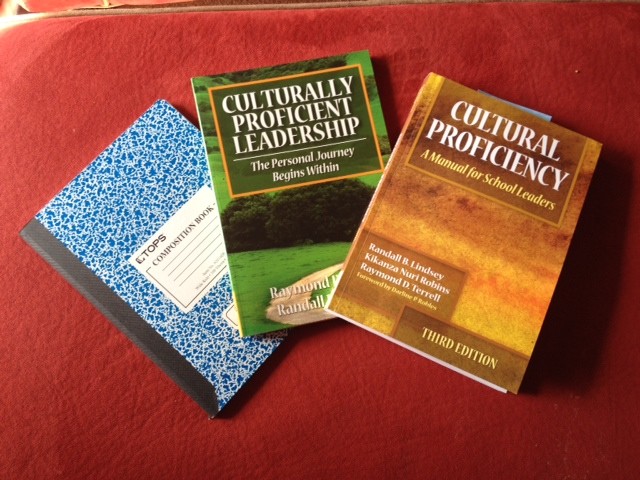
Cultural Prof pic

For those of you who will not take this course anytime in the near future, I want to recommend what you can do to experience the shifts that I have made throughout this journey. I cannot stress enough how important I feel this experience is for every.single.educator in America. We can do a lot to close the achievement gap in our country if we develop cultural proficiency across our educational system; if we, the leaders, become social justice leaders determined to ensure the success of each and every student we serve. 

Step #1: Buy the green book, Culturally Proficient Leadership: The Personal Journey Begins Within by Raymond D. Terrell and Randall B. Lindsey, for yourself. Take the time to complete each and every reflection and activity within the book. Those reflections, including the cultural interviews, began my journey towards cultural proficiency and opened my eyes. This work begins within. You must know and understand your own culture and how your cultural experience forms your perspective. The composition notebook you see pictured above was part of my required work for this class, to ensure that we completed each reflection. [I loved this from the beginning, and if you read my blog regularly at all, this comes as no surprise since I highly value reflection!]

Step #2: Consider buying the green book for your entire staff, to support them in beginning their own personal journey towards cultural proficiency.  

Step #3: Buy the brown book, Cultural Proficiency: A Manual for School Leaders, for yourself and your leadership team. Not only does the content of this book give you the background of the barriers to cultural proficiency and the steps needed to progress along the cultural proficiency continuum, but the Appendix provides an entire set of resources to support you leading your team through critical experiences to explore culture. This work requires the ability to facilitate productive struggles and support people in cognitive dissonance. It is not easy. It is not comfortable. But in my opinion it is critically necessary. 

Step #4: Consider buying and reading The School Leaders our Children Deserve: Seven Keys to Equity, Social Justice, and School Reform by George Theoharis.  This book is a synthesis of real principals who are social justice leaders, working to transform themselves, their schools, and education for all students. This is the practical application of the theory behind social justice, with examples of actions culturally proficient leaders take.  

Bonus Step #4.5: If you are a research junky, consider exploring Educational Leadership: Culture and Diversity by Clive Dimmock and Allan Walker. This is a MUCH drier read, especially the first few chapters, but it provides a global context and research to back up the relevance and necessity of cultural proficiency work. The perspectives from this book tie nicely with the work of Dr. Yong Zhao and the need to “prepare our students to thrive in a global society we cannot yet imagine”.

Step #5: Spread the word. Share the message. Don’t be afraid to have the critical conversations- about race, class, ability, and all elements of culture and the inequities that still exist in our society for certain cultures.

If you are still reading this, thank you. Thank you for sticking with my thoughts and recommendations and lecture. If you read this and take action, please share! Leadership can be an isolating experience. Social justice leadership can be even more daunting and isolating. But, as I wrote in my final course reflection, imagine how quickly we could close the achievement gap if every educator in America went through their own cultural proficiency journey and if every leader was a social justice leader?

 Thoughts for your consideration: 

  • Have you had any courses that address social justice and/or cultural proficiency?
  • How are you a social justice leader?
  • Where is your organization on the cultural proficiency continuum?
  • What inequities exist for students in your organization?
  • How do you address the elephants in the room within your system?
  • Do you have the courage to have the brave, crucial conversations needed to ensure there is equity for all?
Posted in Doctoral Journey | Tagged , , , , , , , , , | 16 Comments

Things I’m Loving Friday, Volume 2

This is my leadership and learning spin on a popular post (here and here). Volume One can be found here.

003

Things I’m Loving Right Now:

  • Protocols:  I have been using pre-made and self-developed protocols for looking at student work, designing learning tasks, and discussing professional readings with colleagues lately. While protocols can feel stiff and impersonal, with the right introduction and support, they actually provide an important structure in which productive, professional, collaborative work can take place. Resources for protocols I’ve used include: National School Reform Faculty website, The Art of Coaching by Elena Aguilar, The Power of Protocols by McDonald, Mohr, Dichter, and McDonald, and Tools for Leaders by Marjorie Larner.
  • Intelligent, hard-working colleagues:  I work with some amazing people! We worked hard to design a collaborative, transparent Common Core implementation plan. While the work is not easy, it is so worthwhile to see how far we’ve come and to celebrate our successes. In spite of the struggles happening across the country due to (in my opinion) poor, weak, or disorganized implementations, we know that our system is learning what alignment looks and sounds like each and every day.
  • Reading to students: This week I participated in Read Across America at one of our schools by reading to two classes of students. It is so nice to stop and read, for pure pleasure, with students. The looks of joy and amusement on their faces make all the hard work and stress worthwhile. Because really, why are we here if not for our students?
  • Slice of Life blogs: I had never heard of the Slice of Life blog challenge until about a month ago. When I stumbled upon it, I spent about 4 seconds considering if I could make the time to participate, but I was wise enough to convince myself that my dissertation writing was what needed to take priority at this time. Nonetheless, I am enjoying how many of the bloggers I follow regularly are participating in the challenge this month. You can see some recent posts by some bloggers I admire here, here and here.


What are you loving right now?

What is rocking your learning and leading worlds?

Posted in Leadership, Learning | Tagged , , , , , , , | 8 Comments

[Abecedary of Reflection] Instinct

I: Instinct

I believe that so much of leadership is about instinct.   

CCC licensed by simple.wikipedia.org

CCC licensed by simple.wikipedia.org

Good leaders must be proactive and visionary, but prepared to react effectively and efficiently in emergencies and crises. So many of these traits cannot be taught in an administrative preparation classroom. Instincts are inherited, not learned. However, leadership traits can be honed through practice experiences and job-embedded professional development.

Though I am not a fan of role playing, due to my introverted nature, I do find value in the process. So often as a leader, we don’t know how we will react to situations until we encounter them. Role playing helps us imagine a scenario and practice our response. The more practice we have, the more supportive we will be in a crisis situation.

Reflective questions to consider:

  • What instincts do you have that help you be a strong, supportive leader?
  • What instincts do you admire in other leaders?
  • How can you continue to develop your own leadership traits to support your work and that of the people and organizations you lead?
  • What other “I” words come to mind when you think of reflection?
  • How do you develop job-embedded professional development for leaders to hone their instincts?


Abecedary of Reflection:

Posted in Reflection | Tagged , , , , , , | Leave a comment

Professional Job Seekers Wanted

In my current role, as well as my former role as a principal, I participate in many interview panels for various positions. I am always amazed at the level of preparation evident (or not evident) during interviews. I have been keeping a running list of the advice I wish to give job seekers. Before applying for a new job or entering an interview, here are my top tips:

  • Do your research! Get to know the position/ site/ district. With all the resources available online these days, there is no excuse not to know the basics.
  • Read the actual job description. Seriously. Be prepared to demonstrate how you are qualified for the specific job to which you are applying.
  • Personalize your letter of introduction so it appears you actually know the job/ school/ district and you didn’t just fill in a few blanks on a form letter.
  • Ensure that your letters of recommendation are as current as possible and are relevant to the position to which you are applying.
  • Know your strengths and be able to articulate them.
  • Provide details- don’t assume we know exactly what you mean, even if you are using a common acronym, phrase, or idea.
  • Always have a question and/or a final statement about yourself prepared.
  • Dress professionally.
  • Express your passion for the work!
  • Make it clear that you are a learner and listener (and not an expert in all areas!) as well as a leader.
  • Demonstrate why you want the job with well-chosen words and actions.

I’ve seen a number of other posts pop up recently, as the season of changing jobs approaches. What advice would you give to potential employees hoping to join your team?

Licensed for use on cc.org by webentrepreneur.ws

Licensed for use on cc.org by webentrepreneur.ws


Posted in Leadership | Tagged , , , , , , , | 4 Comments

[Abecedary of Reflection] Habit

H: Habit 

Talking about building a habit for reflection is not new to me or this blog. I wrote about it here and here. I continue to follow the steps I outlined in the first link, using the book and quotes to guide my not-quite-daily reflection. I continue to look for ways to slow myself down and give myself permission to stop and reflect; to be generous with my time. One of the reasons this abecedary journey has a focus on reflection is to give myself more opportunities to reflect on leadership and learning. As I mentioned when I began, I learn about myself through my writing and this journey is a written copy of my reflection.

CCC work by jaynealinternational.ws

CCC work by jaynealinternational.ws

When I think about building habits, I think about the healthy habits that I’ve developed over the last three years. I work out daily, making the time to exercise for my health. I track my food through a variety of online apps. I drink water every day (a LOT!). I prepare my food for the week on Sunday so I have no excuse not to eat well during a busy week. I also remind myself how important moderation is- I’m not looking for perfection, but for a balance of more good/healthy days than not-so-good days/meals/choices.

But I also think about how hard it has been to develop other habits, such as putting my fork down after every bite, or putting away my laundry as soon as it is clean. Different activities take different skills to become habits.  

Reflective questions to consider:

  • What habits are you proud to have in your repertoire?
  • What habit do you wish to improve upon in your life?
  • How do you build a new habit?
  • What habits do you think are crucial for a successful leader?

Abecedary of Reflection:

Posted in Reflection | Tagged , , , , , | Leave a comment

Exhausted

I am exhausted.  

Image

Photo by Jessica M. for http://www.examiner.com, licensed under Creative Commons

For awhile I felt guilty thinking this, much less writing it. But then I actually stopped and thought about all I am doing lately and I got exhausted just making the mental list. I thought that if I put it out in the world, to others who do even more than I do on a daily basis, I might not feel alone in my exhaustion. I’m allowing myself to be generous about my time.

Lately, here is what I’m doing:

  • Getting up at 5 am to workout for an hour every work day
  • Working a full day in a mentally challenging (and therefore often taxing position!), which could be a blog post in and of itself, as a district leader in a district fully implementing the ELA Common Core State Standards, leading professional development, coaching, and learning every day
  • Working out with a personal trainer two days a week for an hour each session
  • Working on my doctoral program which right now involves attending two classes this semester (EVERY. Saturday.), doing the required homework, working on a practicum requirement for a third class, and preparing for a presentation of my first three chapters and the work to get IRB approval
  • Visiting with family and friends once in a while (in person, on the phone, or through social media)!
  • Remembering to do the laundry, clean the house, get the car repairs on time, etc.
  • Trying to squeeze in at least one yoga class a week for my physical and mental stability
  • Going to a chiropractor and a masseuse every other week to work on my chronic back pain
  • Trying to write 1-2 blog posts a week, not because I have to, but because I enjoy writing
  • Checking my fitbit status on the leaderboard to see if I even came close to an average of 8-10,000 steps a day
  • Reading for additional information personally, professionally, etc.
  • Trying to remember to STOP. REFLECT. RELAX. PAUSE.

I am very grateful for the four-day weekend I am about to begin. I am giving myself a lot of permission to rest, in between workouts and homework, of course!

Posted in Reflection | Tagged , , , , , , , , | 4 Comments

[Abecedary of Reflection] Generous

[Abecedary of Reflection] G: Generous

CC licensed work by jimmartin.typepad.com

CC licensed work by jimmartin.typepad.com

Are you a generous person? Are you generous with your celebrations? Are you generous with your time? Do you give yourself permission to take the time necessary for reflection?

We give so much praise when individuals are generous with their time, money, and resources, giving and sharing above and beyond the norm. But how often due we allow ourselves to be generous with our own time. This journey of reflection makes me stop and pause about our beliefs in time. Taking time for ourselves. Honoring the time necessary for true reflection. I hope to be more generous with myself, building in the reflection time I need to stay balanced. I also hope to honor when my colleagues are generous with me and with themselves, in the hopes of greater reflection!

Reflective questions to consider:

  • How can be more generous with your words, actions, and with yourself?
  • How do you make time for reflection?

Abecedary of Reflection:

Posted in Reflection | Tagged , , , , , | 3 Comments

[Mentor Text Monday] Blogs & Pictures

I’m taking this mentor text in a different direction today. Since this is a blog post, I’m going to demonstrate how I use another writer’s blog as a mentor text for my own blog post. Barb’s post on using pictures as mentor texts really inspired me to try on her ideas so, here goes! Using a blog post, about using pictures as a mentor text, as a mentor text.

© 2014 Fascinating Pics

© 2014 Fascinating Pics

 Barb’s post asks us to first write what we notice in the picture, or to “read” the photo.  Here is what I first notice:

boat, huge wave, no people present

Setting

  • The settings appears to be on water, a large body of water such as an ocean, to produce such a large amount of water surrounding the boat.

Point of View

  • The picture seems to have been taken by someone standing on a level higher than the deck about to be submerged in water.
  • It is also possible that the end of the boat on which the photographer was standing was higher (as if in the air) while the front end of the boat was dipping down, or diving, into the water.
  • It doesn’t feel like the photographer is in danger of the water.

Plot

  • Right before this, I imagine that the people on board the boat heard a warning sound and were able to run to safety at the other end of the boat.
  • Right after this picture was taken, I imagine the waves making direct contact with the boat. This would lead to unimaginable damage and chaos, as wood is crushed, people and objects are thrown into the air and submerged under churning waters.

Characterization

  • With no “characters” present in the photo, I’m left to wonder about the photographer’s presence in this scene and whether or not anyone else is around.

Wonderings

  • Did the photographer put him or herself in danger?
  • Where was this photo taken?
  • What happened to the boat?
  • Could someone survive something like this?

As I dissect each of these elements, following along with the model of my mentor text, my brain is churning with story ideas. I could easily use this picture to create a narrative. I could also use this as a springboard for research about tidal waves, tsunamis, or boating incidents, leading to some sort of informative writing. Armed with such information, I might be able to write an argumentative piece about boat safety. Wow! Hitting all three of the main text types called out in the Common Core State Standards just from one picture. Imaging what students could do with this?

  • Have you used pictures as mentor texts with students?
  • What other websites or resources do you recommend for finding engaging, writing-worthy pictures?
  • What stories do you notice in the pictures below (the last one is one of my favorites!)?
    From @Perspective_pic

    From @Perspective_pic

    Rabbit Dreams from @Perspective_Pic

    Rabbit Dreams from @Perspective_Pic

    mirror


Posted in Mentor Text Monday | Tagged , , , , | 3 Comments