Rejuvinate

My focus word for 2016 is rejuvinate.

Rejuvenate 2016

While this is not something I consciously think about every day, I do make an effort to ask myself these questions when planning activities or making decisions that impact my schedule:

  • Will this rejuvinate me?
  • Will this bring more or less energy into my life?
  • Will I feel better (mentally, emotionally, physically) after I do this?
  • Do I need rest more than this?

Asking myself these questions has kept rejuvenation within my focus, giving me permission to choose taking care of my health above many other things that feel important, but aren’t nearly as important!

Some things I’ve done in the first two months of this year that have rejuvenated me:

  • Virtual writing dates with a good friend!
  • Sunsets (on the non-rainy days!)
  • Rest (allowing myself to choose this when needed has been empowering!)
  • Lots of green juices and smoothies
  • Essential oils
  • More reading for fun
  • A major tidying up of my house

What is your word of 2016?  How do you stay focused on it throughout the year?

Posted in Reflection | Tagged , , , | 8 Comments

Fixed Mindset Painting

I am a HUGE proponent of Carol Dweck’s work around cultivating a growth mindset in schools. School cultures can benefit from a focused effort on this for students and adults. I have a growth mindset in many areas of my life.  I am a lover of learning and I know there are always ways to grow.  However, when it comes to one specific area in my life (dating back to my middle school years), I have a fixed mindset.

ART.

Since seventh grade, and a negative year-long experience in art class, I have believed that I have NO TALENT when it comes to art.  A teacher not only demonstrated that through her actions, but she basically said that to me too.  For a student who tolerated school, but loved learning, this was heartbreaking.  I have carried around the belief that I am awful at all things artistic and creative ever since that time.

Over the last few years, thanks to growth mindset and adult coloring and technology and writing, I have taken creativity out of my fixed mindset box.  I know that I am creative and I have a lot more room to grow in that fun area.  But it wasn’t until last week that I saw a glimmer of possibility for my artistic abilities.

My friend and I went to a painting class.  She actually gifted me this experience months ago, but this month was the first time we both had a free afternoon on a day when the class was painting a picture we both actually liked.  This was such a fun experience for me!  Since then, I’ve been reflecting on what elements helped me be successful and what chipped away at my fixed mindset.

IMG_4440

The teacher’s sample that we were to emulate

Location

When we arrived, I picked out seats for us near the back of the class, and then quickly realized the benefits of sitting right up front by the teacher.  By sitting in the front, we had a good view of the teacher modeling each step of the process as well as a sample finished product (see above!).  It was good to see our intended outcome as well as each phase along the way.

Modeling and Scaffolding

As mentioned above, the teacher modeled each step of the process for us.  It was overwhelming to look at the completed sample at the beginning of class.  I couldn’t imagine how I would ever do anything similar.  But the teacher gave clear instructions as well as modifications, while also encouraging us to make our piece unique in any way we felt comfortable.  She never took away the scaffolds in this lesson (which was good for someone like me!), but now that I’ve experienced one class, I believe I could rely on the scaffolds a little less in the next class.

Praise & Feedback

Throughout the class, both the teacher and her assistant walked around the room providing us with praise for the work we were doing.  At first, I thought it was generic, almost condescending praise.  But when the teacher noticed I chose to paint one building a different color than her model, I realized she was truly getting to know my work as an individual and I appreciated the positive feedback.  Both instructors were also willing to provide constructive feedback to anyone who wanted additional support.

Laughter

Even without partaking in the wine at this wine and palette class, my friend and I spent a lot of time laughing during class- laughing at ourselves, at the class as a whole, and just finding humor in the entire experience, which made 4 hours fly by!

Open-ended expectations

While we all signed up to paint a specific picture, the teacher and her assistant were very encouraging about our final product being whatever we wanted.  They encourage us to experiment with colors and shapes and differentiated based on student requests.  Two of the women sitting next to us painted their buildings teal with a bright purple background, which as you can see in the model above, is nothing like the original color palette.  As a rule follower just discovering some creativity, I stuck to the teachers’ model most of the time, but I enjoyed the encouragement to think outside of that box.

All of these elements make me reflect on a typical classroom.  Do we provide students with a choice of where to sit?  Do we model and scaffold when appropriate (I actual think we over scaffold too much!)? Do we provide students with praise and constructive feedback throughout the learning day?  Do we hear laughter in our classrooms?  Do we provide opportunities for learning with open-ended expectations?

If my middle school art classes had included more of these elements, I might have avoided 20 years of a fixed mindset when it comes to art.

Below is a video of my experience! Click to view it in Flipagram!


Posted in Learning | Tagged , , , , , , , | 5 Comments

Twitter Chats

I find Twitter chats to be so invigorating!  If I could, I would persuade every educator in the world to participate in at least one chat (lifetime goal!).  Because once you’ve experience one exciting chat, you are often hooked and ready for more!

search

There are a few chats that I try to participate in every week I can (#educoach, #satchatwc).  Some chats I join because I am passionate about the topic.  Others hook me because of the host/ moderator or the other participants.  Some nights I just enjoy the collaboration (while in pj’s on my couch!).

Today I will be meeting with some teachers in my district to discuss ideas for creating a district-wide Twitter chat (I’m chipping away at my goal slowly but surely!).  I find that one of the easiest ways to help people start is to invite them to come together to participate in the chat in a common location.  This provides an added level of support for those who feel they are less tech-savvy.

hashtag

Questions for reflection and consideration:

  • What do you enjoy about Twitter chats?
  • How do you select which chats to participate in and why?
  • How have you (or could you) bring other educators into the world of Twitter chats?
  • What Twitter chats do you enjoy/ recommend to others?
Posted in Reflection | Tagged , , , | 4 Comments

Preparing for Success

IMG_4472

After spending a few hours last Sunday prepping all of my food for the upcoming week (meal planning, chopping vegetables for lunch salads, cooking and storing dinner for four nights, etc.), I began to think about how we prepare for success in life and at work.  I prep my food for the week so that I can be successful in my healthy eating, which leads to less stress, more weight loss, and a better feeling overall (my word of the year IS rejuvenate!). When I was a teacher I never thought about the preparation of my leaders (though I noticed when there was a lack of preparation!). I believe I assumed they were naturally gifted at on-the-spot presentations and I just hoped that skill would appear in my toolbox someday.

I’ve worked with new leaders who enter into a position assuming that all leaders are naturally gifted speakers who can jump up at a moment’s notice to give an important presentation or open up a full-day of professional learning or provide a teacher with meaningful, relevant feedback.  One of the first items I coach new leaders about is preparing for success.  Leaders are made in the preparation.  Yes, there are good leaders who can think on their feet and be eloquent.  And the more experience you have, and the clearer your own personal mission is, the more you can grow into this. However, the vast majority of people I know and have worked with, speak more articulately when they have taken the time to reflect about the comments they plan to make.  It is well worth it to make time in our schedules to prepare for important events so that we communicate our vision.

Every time a leader speaks, they are sharing their beliefs.   A well-spoken leader demonstrates care for the content, the people, the teamwork, and the vision.  A leader who jokes around but never addresses the purpose can appear to not care about the learning or the people within their system.  The first few minutes of a professional learning opportunity can make or break it for participants.  A clear, focused, opening that sets the purpose of the day, aligned with the vision of the system, with an acknowledgment of the specific people in the room who took time out of their lives for this learning event, can draw people into the learning.  A different opening can turn them off quickly.

I think we would be wise to make our preparation more public so that aspiring leaders can see that inspiring leadership takes time, just like great teaching takes time.  Teachers work so hard to be prepared for students’ success.  I would like others to realize that all of the amazing leaders I have worked for and with have also worked hard to prepare for success.

success


Posted in Leadership | Tagged , , , | 1 Comment

January Reading Update

Last year I participated in #Read15in15 and was so inspired to keep a record of all that I read, I ended up reading more and remembering more! My final 2015 reading list is here.  I plan to keep a running list again this year to remember what I’ve read and to contribue to #Read16in16!

Carrie Gelson  recently shared her experiences with reading each book on her list in 2015 and I love that idea so much more than a summary!  Here are the reading experiences I’ve had in January.

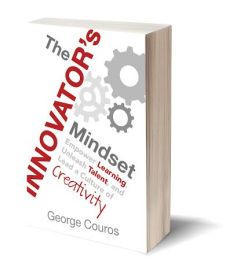
  1. The Innovator’s Mindset: Empower Learning, Unleash Talent, and Lead a Culture of Creativity by George Couros – I’ve been wanting to read this book since the day I knew it was coming out. The book came from a good friend, with her stamp of approval, which means a lot in my world. I appreciated George’s message.  He quotes a number of experts from a variety of fields, but his message is simple.  We can all innovate, and we should, on behalf of our students.  I spent a lot of time nodding as I read this book, and I would love to discuss it with colleagues.

  2. Defending Jacob by William Landay – I loved reading this book!  It was a great mystery that kept my interest through various twists and turns.  I enjoyed getting to know, and dislike, many of the characters!  In the e-book I purchased, there was an interview with the author at the end.  I loved reading about this author’s writing process; reading this book made me dream of writing a mystery!       51NS+-RIohL._SX329_BO1,204,203,200_
  3. Anne of Green Gables by L.M. Montgomery – This was one of my childhood favorites.  I ended up listening to the audio version of this book after buying the second volume in the series (when the first was unavailable in the bookstore at the time of purchase).  I loved hearing the old, familiar story, but wish I had read it in print again to highlight all the beautiful, descriptive language that weave the story together. Listening to this reminded me of how much I wanted to be a writer as a child, especially of beautifully written works of fiction.                imgres-1
  4. Fates and Furies by Lauren Groff – This was an interesting reading experience for me. This book was recommended by The Skimm, my favorite shot of daily news! I think I was expecting to love it, but it took me about 200 pages (eek!) to do more than tolerate it.  When I got to the second part, which is narrated by the wife, I realized that I had not enjoyed the first part because it was narrated by the husband.  I was so much more intrigued about the wife, who we saw only through her husband’s eyes in part one.  The second part was much easier to read and more entertaining as a story for me.  This book will not make my top ten this year (I’m sure!), but it was fun to read outside of my comfort zone.                                       fates and furies
  5. Escape from Mr. Lemoncello’s Library by Chris Grabenstein – This was such a fun YA book to listen to on Audible!  I liked the mystery aspect, but I LOVED all of the book references throughout the entire story!  I wonder how many young readers would get all those references, but I enjoyed them!                                                                    lemoncello library
  6. Somebody I Used to Know by David Bell- I know that when I get a text from Melanie that reads something like, “I just started this book and I’m ready hooked,” I must read the book as soon as possible.  This was a great mystery that kept me hooked throughout the entire twisted story.  I liked the main character and enjoyed seeing the world through his eyes.                                                           514e3EC0O5L._SX331_BO1,204,203,200_


It is my goal to publish my reading lists each month this year and then do a year-long wrap up like I did for 2015.

Posted in Reflection | Tagged , , , | 4 Comments

Factors of Motivation and Engagement

As part of the state-wide implementation of the Common Core State Standards, California published an incredible document for educators- the ELA/ ELD Framework. Chapter two details “Key Considerations in the ELA/ Literacy and ELD Curriculum, Instruction, and Assessment”.  Within this chapter is a section on motivating and engaging learners, which identify key factors for motivating students:

  • Interest (relevance)
  • Choice (autonomy and self-determination)
  • Success (self-efficacy or the believe that “I can do it”)
  • Collaboration & real-world interactions (social relatedness and active engagement)
  • Dedication (identification with being a good student, persistence, and willingness to work hard to achieve goals)
  • Goal setting, self-regulation, and guided self-assessment
As educators we are constantly striving to find the best ways to motivate and engage our student learners.  As leaders, are we doing the same for our adult learners? Reading this chapter from the ELA/ ELD Framework made me reflect on engaging teachers and leaders in professional learning.
  • How often are teachers’ interests taken into consideration when planning professional learning?
  • Are the adult learners in your system given choice to create their own professional learning pathways?
  • Do the adults in your system have the self-efficacy to believe they can help ALL students be successful?
  • How do we provide opportunities for adults to collaborate and engage actively?
  • How do adults set professional learning goals and assess their progress?

“Everybody is a genius.  But if you judge a fish by its ability to climb a tree, it will live its whole life believing that it is stupid.” ~ Anonymous

A critical role of a leader is to build respectful, trusting relationships.  With that foundation, people will often follow a decent leader wherever he or she may lead. However, in today’s educational climate, with the achievement gap glaring at us, and 21st Century skills not even accessible to all students and staff, it is even more important that leaders seek to motivate and engage the adult learners in their systems.

The factors listed above are a great place for a transformational, social justice-minded leader to begin when considering the professional learning needs of the adults within an educational setting.

How do you, or how will you, motivate and engage adult learners today? 

Posted in Leadership | Tagged , , , , , , , | 2 Comments

Quotes That Resonate

I ended 2015 and entered 2016 determined to read more (and watch less bad TV!).  As I read, I highlight lines that stand out to me.  Below are a few quotes from my recent readings that resonated with me.

imgres

“The way you view change- in education, technology, and life- shapes the way you lead.” ~ George Couros, The Innovator’s Mindset: Empower Learning, Unleash Talent, and Lead a Culture of Creativity


Change is such a challenging dynamic in education.  Leaders play a critical role in how change occurs in a school or district and how new initiatives succeed or fail.  Leadership in times of change is also about knowing your people and ensuring you have created safe, trusting environments where people are willing to take risks for changes that will impact student learning.

“When trust, respect, and clear communication are cultural norms, teachers are more comfortable sharing ideas and learning from each other.” ~ Jim Knight, Better Conversations: Coaching Ourselves and Each Other To Be More Credible, Caring, and Connected 

Trust, respect, and communication go a long way for any teacher, coach, or leader.  These elements must be present and authentic for real learning to occur with students or with adults.  High-functioning PLCs are the model of this quote!

“Research indicates that poverty has a significant impact on the brain and its ability to learn. Perhaps as toxic as drugs and alcohol to a young child’s brain, poverty not only affects the development of cognitive skills, but it also changes the way the brain tissue itself matures during the critical brain “set up” period during early childhood.” ~ Martha Burns, “How Poverty Affects School Success,” from Smart Blog on Education

Every time I read anything about poverty, I am struck by the brutal realities.  So many children in America are growing up in poverty and it does affect their lives inside and outside of school.  Educators need more information on how to support students living in poverty and how to rally a community together to make meaningful change.

“Where online can I see the trail of magic you regularly create?” ~ Seth Godin, “No Direction Home” blog post

I love this as a possible interview question.  In this day and age, we all have a digital footprint, unless you live under a rock and work to actively avoid making a digital mark publicly.  This quote encourages the regular writing of a blog, or posting of pictures or pins or tweets, which I appreciate. It also implies that one has moved beyond the stage of lurker and into that of contributor in the global world.

“‘professional learning’ implies an internal process in which individuals create professional knowledge through interaction with this information in a way that challenges previous assumptions and creates new meanings.” ~ Timperley, Helen (2011-06-01). Realizing The Power Of Professional Learning (Expanding Educational Horizons (Quality) (pp. 4-5). McGraw Hill International. Kindle Edition.

This book is all about shifting from professional development to professional learning.  I love the process described here, where true learning takes place after you interact with new information to create new understanding.

“My aspiration to become a jurist had been laid to rest in the Graveyard of Failed Hopes, an all-female establishment.” ~Kidd, Sue Monk (2014-01-07). The Invention of Wings: With Notes (Oprah’s Book Club 2.0 3) (p. 88). Penguin Publishing Group. Kindle Edition.

This was such a powerful book about the lack of rights for African Americans before and after slavery and the lack of rights of women.  This particular quote was a thought by a future Suffragist and I was drawn to the detailed, vivid description. [And I love fiction writing so much I had to include one!]

“Effective teacher professional learning is motivated by their need to know rather than someone else’s desire to tell.” ~ Timperley, Helen (2011-06-01). Realizing The Power Of Professional Learning (Expanding Educational Horizons (Quality)) (p. 14). McGraw Hill International. Kindle Edition.

Another quote from a book listed above- this one jumped off the page at me!  Learning is driven by an individual’s desire, not a mandate.  How are we encouraging professional learning that is individualized and personalized?


What quotes have resonated with you lately? 

Posted in Reflection | Tagged , , , , , , , , , , | 4 Comments

Critical Consumers

During my doctoral studies, one of the first things I learned (or truly understood in application) was the importance of being a critical consumer of educational research. I spent hours reading research and asking questions such as:

  • Who conducted this research?
  • What was the context of the research study?
    • Location (urban or rural, local or international), participants (how many, what demographics), and methodology (survey, interviews, observations) all tell a story.

So much in education is contextualized and not easily replicated by copying another school or district’s idea exactly as is. One of the challenges of being an educational leader is situational leadership- knowing your constituents and their specific needs at any given point in time based on the context.

Well, today I was reminded to be a critical consumer once again by two very different sources.

First, you must know that I recently finished binge-watching the Netflix documentary “Making of a Murderer” (thanks Dad!). I loved the series for hooking me and keeping my interest, and was once again sad thinking about our justice system. I went through many of the same emotions I felt while listening to both Serial and Undisclosed podcasts. After finishing the series, I was less concerned about the guilt or innocence of the key characters, but was more concerned with the evident miscarriages of justice that were portrayed.

I didn’t realize how uncritically I had consumed this documentary until I read this editorial and a few more articles about the series as a whole. While I may not agree with the editorial, it gave me pause for thought. I had watched the entire documentary assuming I was getting the whole picture even though it was heavily slanted to the defendant’s side.

My next reminder to be a more critical consumer came when I saw this tweet:

It sparked my interest enough to click on the link and read the article. The article cites a variety of sources (research and non-research-based) which claim that education’s focus on different learning styles (aka Howard Gardner’s work) was not grounded in valid research.

“In his paper on the subject for Nature Reviews Neuroscience, Howard-Jones argues that it’s not a result of fraud, but of ‘uniformed interpretations of genuine scientific facts.'”

Reading this article forced me to consider my role as a critical consumer. I did do some additional reading (as well as having a brief twitter conversation with the person who tweeted out the link) about both the author and some of the citations within the article. Just like I’m not declaring the people in the documentary guilty or innocent, I am not stating whether or not learning styles are worthless for educators to consider. I am, however, asking myself some different questions such as:

  • How are research-based practices brought to mainstream educators?
  • How do educators ensure they stay current on research trends in education?
  • What research should inform educators making decisions framed to be in the best interest of students?
  • When someone labels a strategy, program, or initiative as “research-based”, how do you confirm the research, especially as it applies to your context?

These recent experiences have reminded me of the importance of being a critical consumer within my life- of research, when making important decisions, and without judgment.


Posted in Leadership | Tagged , , , , , , , , | Leave a comment

Using Your Strengths at Work

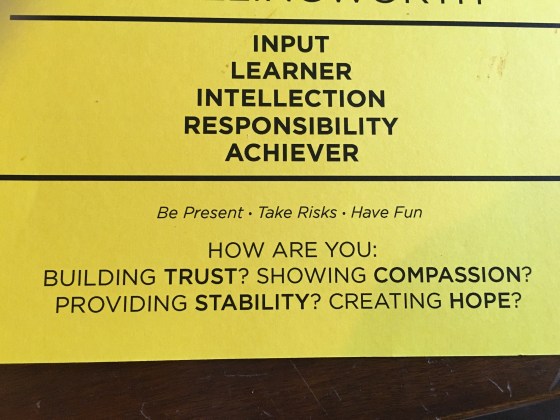
In an earlier post, Coming from a place of strengths, I wrote about my experiences taking the strength-finder quiz at least two times in my life. Two years later, I am reflecting on my strengths once again. Today I’m wondering how I am using my strengths at work.

jfk-p_kot0ey1ro8fqrv3a

Around 2005, my strengths were:

  • Strategic
  • Input
  • Learner
  • Achiever
  • Self-Assurance

In 2013, my strengths were:

  • Learner
  • Input
  • Achiever
  • Deliberate
  • Strategic

After you take the quiz, the results are generated and shared with you in a report that explains each strength in more detail. The order of the words is important- almost from strongest to least.

As I look over my two lists, it makes me happy that Learner moved into the top spot the second time I took the quiz. I always consider myself a learner (see my very first blog ever!) and in 2013 I was in my doctoral program, living a student life (while working full time!). In my new job, I am most definitely a learner- as I learn a new district, new schools, new staff members, and a new culture.

The Input strength has always connected to Learner for me. Rath and Conchie describe, “People strong in the Input theme have a craving to know more. Often they like to collect and archive all kinds of information” (p.191). I am a collector of words, ideas, books, articles, and information to be read and learned!

Achiever is accurate in the drive I have to reach my professional goals. I seek out new opportunities, and then I work to make them a reality. I work hard to achieve the success I have. However, because I am an introvert, you will not usually find me shouting about my own successes from rooftops. I like to achieve with a team, celebrate together, and receive praise as a team or in private. I do not enjoy, nor do I seek out, public recognition for every achievement.

Between my two quizzes, Self-Assurance disappeared and Deliberate appeared. I think this transition nicely captures my transition from being a new site principal to being a district leader with many more years of experience. I have always had confidence in my abilities at work, but the longer I have been a leader, the more I recognize how much more there is to learn. I have become much more deliberate in my actions, and even more so with my spoken words. “With time comes wisdom,” or so they say.

Strategic was once my number one strength and now it is my fifth. I don’t think I have become any less strategic in my work, but I think that over time I have learned how to facilitate strategic discussions with others. I have worked hard to build capacity in those around me, so that I am not making decisions in isolation. I have done this strategically!

As I reflect on my strengths, according to Rath and Conchie, I recognize how I am able to use them within my current work. Is there room for improvement? Always!

I think it is just as important for me to get to know the strengths of those with whom I work, to better tap into their strengths in our collaborations. We are better collectively than we are alone.


What are your strengths?

How do you use your strengths at work? 

Posted in Leadership | Tagged , , , | 4 Comments

Day in the Life at Work

During 2015 I wrote three Day in the Life posts, capturing what three very different days looked like in my job as a district administrator. In November, I changed jobs. I am still a district administrator, but in a larger secondary district, as opposed to a smaller elementary district. Here is what one of my days looked like during my first month on the new job!

7:15AM- Arrive to work for an early morning final round interview with a candidate for a position I will be supporting. Three of us had an honest chat about the work and then the job was offered and accepted!

San Diego driving

ccc licensed work from en.wikipedia.org

7:45AM – Race out of meeting to drive across town for a site visit with a high school principal. I’ve made it my goal during my first month or so to meet with each school principal individually, at his or her site, to get to know people and sites. The principal and I discuss the school’s vision, current professional growth needs, and then go out to visit classrooms. I found out later that one of the teachers I observed is married to a teacher from my former district (small world!).

9:30- After leaving my first site visit, I stop by to visit with a former colleague since I was literally driving by my old office. We have a quick chat about our work and then I’m off to the next site.

10:00 AM- Now I’m at a middle school that happens to feed into the high school I visited this morning. It was great to see signs of articulation and discussion between the principals. During classroom visits here, I met a teacher I had already connected with on Twitter, which was fun!

11:15AM – After this site visit, I head back across town to the district office. During this first month I have driven over 100 miles around my new district!

11:45 – I eat my lunch while I catch up on some emails in my office.

email pic

CCC licensed work by Pixabay user Nemo

12:20- After lunch I head over to another school, my second middle school visit of the day. For this visit, the principal invited me to sit in on her weekly meeting with her instructional leadership team. This was a great experience for me, as I am getting to know the site and the district work. I loved hearing a group of teachers plan how they would facilitate the staff professional development day the following month! The principal has built capacity within her site for teacher leaders to step up and be confident in their leadership.

3:30PM – I return to my office to do one of the hardest, but most important tasks I have. Today is the day I am calling the people who interviewed (for the position I offered this morning!) but were not selected for the job. While I never enjoy these calls, I find it important for me, as the lead interviewer, to call and give personal feedback to all who made it through multiple rounds of interviews. Interviews can be so stressful and we had many great candidates for this particular position, so it was easy to give positive and constructive feedback.

4:30PM- Tonight our district’s administrator group is hosting a gathering, so I head out (adding more miles onto my tally for the week!) to meet some of my new colleagues. I see some familiar faces in the crowd, including some people I had just met this morning on site visits, which was nice.

7:00PM- By the time I get home, it is dark and I am tired of driving! But I am happy about all the classrooms I visited and the people I met today. All these visits remind me of how much I loved teaching middle school! I end my day by vegging out in front of some mindless TV before getting ready for bed (and my usual 5:00 AM wake up alarm!).


What does a day in your work life look like? 


Posted in Leadership | Tagged , , , , | 1 Comment