Blogging Trends in 2019

The end of the calendar year is a great time for reflection, as is July for us educators as it represents another transition between two years. I began this blog in July, so I often reflect on my blog’s “birthday”.  Over the last few years, I’ve also done an end-of-year wrap up in the form of a short summary.  This is what 2019 looked like on Reflections on Leadership and Learning.

My favorite blog topics this year:

My most read blog posts from this year:

The month in which I published the most posts:

  • April and October tied with 6 posts each!

The top countries where my blog readers live (outside of the US):

  • Phillipines
  • Canada
  • United Kingdom
  • Australia
  • India (new to the list this year!)

Terms people searched that helped them arrive at my blog:

  • inspirational reflections on leadership
  • elena aguilar core values
  • strengths based coaching
  • importance of the art of questioning

Blogging goals and reflections:

  • At this time last year, I mentioned that I was going to finish my book early in 2019.  I’m proud to have met that goal and to have blogged about it! #CoachADV is available on Amazon and Barnes and Noble.
  • My other goal from last year was to blog more in 2019 than I did in 2018. I met this goal, thanks to my monthly Onward reflections and reading updates. I don’t know if there will be a monthly series on the blog next month, but the ideas always come to me when I need them!
  • I enjoyed challenging myself to capture more about the books I read, in order to continue to diversify my reading choices. In 2020, I hope to read even more diverse books.
  • I will continue to use this blog as a source of reflection. I enjoy writing and appreciate that anyone is interested to read my posts.  I look forward to another great year in 2020!
Posted in reflection | Tagged , , , , , | Leave a comment

December Reading Update [2019]

I’m so proud of not only how much I read, but the diverse things I read this year.  I’m publishing this in mid-December, as I’m about to leave on a vacation.  I know I will read more at the end of the month, and those books will appear on my “What I Read in 2019” post that will come out in early 2020 (as I’m fighting jetlag after my return!). In the beginning of December I read:

  • Ask Again, Yes by Mary Beth Keane – This was another book recommended by Laura Tremaine, of 10 Things to Tell You podcast. I like her recommendations, but I didn’t know what to expect from this one. It’s a story about two families across four decades, and multiple generations. There is love, loss, tragedy, and hope. I enjoyed Francis, Lena, and Kate, and I was annoyed by Anne, Brian, and Peter. These were very real people, with significant flaws and deep love. It was an interesting family saga.
  • Inheritance: A Memoir of Genealogy, Paternity, and Love by Dani Shapiro – I LOVED this memoir!  As with the previous book, it was a recommendation from my favorite podcast, and so worth the read. Dani completes one of the ancestry tests and sends it in, and slowly her entire life changes.  Through the testing, she learns that her father was not her biological father. As she explores family connections, and artificial insemination research from decades ago, she also explores her own place in the world. I loved reading her reflections throughout the journey, and the sweet way her biological father learned to embrace this shock.
  • Full Circle: From Hollywood to Real Life and Back Again by Andrea Barber [audiobook] – It feels like it’s been forever since I listened to a celebrity-read memoir. I loved the show Full House and enjoy the reboot, Fuller House, and this actress.  I love that her favorite band is my favorite band (The New Kids on the Block!). I appreciated her honesty about her mental health struggles, her divorce, and the love her TV show family has for one another.  This was a short, sweet story by a genuine, down-to-earth person.
  • Maybe You Should Talk to Someone: A Therapist, Her Therapist, and Our Lives Revealed by Lori Gottlieb – I’ve had a hold on this book through my library app for months, after hearing about it on, you guessed it, my favorite podcast! It’s a fascinating look into therapy and the connections we need as humans to survive and thrive. I loved as Lori got to know herself through her own therapy and through her being a therapist for such a wide cast of characters. It’s always nice to read about other people’s problems to help bring gratitude into your own life.
Posted in reflection | Tagged , , , , | 1 Comment

Building Resiliency: December

In January I began a deep dive in Elena Aguilar’s Onward: Cultivating Emotional Resilience in Educators and the accompanying workbook. I hope to share some of my reflections as I build daily habits to strength my own resilience and support that growth in others. Aguilar outlines a habit and a disposition for each month of the year. Follow along as I reflect on each month’s key ideas.

December’s habit is Focus on the Bright Spots and the disposition is Empowerment.

I love that this is the last chapter of the year, and therefore the last chapter I have left to reread. Focusing on the bright spots is all about a strength-based approach, which is how I view coaching. Everyone appreciates being seen, and being recognized for their hard work and their efforts. Acknowledging the positives we observe makes both the observer and the receiver feel good!

“The brain perceives negative stimuli faster and more intensely than positive stimuli.”

This is such an interesting and sad fact. I know from personal experience how I can have a great day full of positive interactions, but if there is one negative interaction I will perseverate on it for hours afterwards. Aguilar reminds us that this is why we develop the habits throughout this book, to tell retrain our brain to focus on the bright spots in each moment. The more resilient we are, the less the negative thoughts will stick with us.

“When we focus on our strengths, we can access the positive emotions that open us up to learning. Whether we’re looking at our own behavior or that of our colleagues, students, or bosses, what we focus on grows.”

Aguilar advises us to work with our mind to set intentions to enter situations with a positive frame of mind. We can train our brain to work with us, instead of against us. She also recommends an inquiry stance, where you seek to understand through questioning. This is also how I like to approach coaching, presuming positive intent and seeking clarification so I can support.

As I continue to read this chapter, I am reminding of the entire purpose in rereading this book.  This is an entire way of thinking, of reflecting, and of being. It takes time to develop new habits, and to retrain my own brain to focus on the bright spots. I used this blog series as a way to dive back into the book, but my reflection has gone far beyond the 12 blogs I’ve posted about it. I am very reflective by nature, and I write in my own personal journal, I write in a professional journal, and I blog, because I reflect best by writing, and then by talking to trusted friends. I love reading this, because it reinforces my current reflection tools.

“I know how powerful it is to write down your reflections, and I know that this build resilience.”

The disposition of empowerment is such a great way to end this chapter, and this year of rereading.  When we are empowered, we have self-efficacy, we believe we can be our best. We are resilient.

I hope you’ve enjoyed coming on this year-long journey with me.  I am so grateful to Elena Aguilar, for all of her research and her willingness to share it with us through her amazing professional books. I think that Onward is a great book to give each new teacher and each new principal at the start of a new job, as they enter the most challenging year of their profession. Every educator I know has struggled with their own resiliency.  We all need this work, and we need to be talking about it, together.

Posts in the Building Resilience series:

Building Resilience

Posted in reflection | Tagged , , , | 3 Comments

November Reading Update [2019]

It’s hard to believe that this year is almost over. This month I read:

  • Daisy Jones & The Six by Taylor Jenkins Reid – I heard about this book from a number of different sources, so I knew I would enjoy it.  The story is about the rise and fall of a fictional famous band in the 70’s, following their rise to fame, relationships, demons, and more.  It’s told like a long interview or like you are reading a documentary, which makes the band feel so real. It made me want to google their music, which was so interesting, as the author made them so believable.  It’s a fun read!
  • Hope and Other Punch Lines by Julie Buxbaum – This is a beautiful YA book written about the lives affected by 9/11. While the story is fiction, it felt so real to read about these characters, Abbi and Noah and their friends and family. Abbi is famous because she turned one on 9/11 and was saved before the World Trade Center buildings collapsed, and her saving was capture in an epic picture.  Years later, she is haunted by that image of herself, and Noah is haunted by someone else in that picture.  I loved reading how their stories came together!
  • Girls Like Us by Cristina Alger – This was another great book recommendations by Laura Tremaine from the 10 Things to Tell You podcast. It was a fast-paced mystery by an author I’ve enjoyed before. It was actually a little short for me. I think the character of Nell could have been more developed with the details that were shared only very briefly.
  • Burnout by Emily & Amelia Nagoski- This book was recommended on 10 Things to Tell You.  Since I love that podcast so much, I thought I would love this book.  The truth is, I loved parts of it, but was underwhelmed overall.  I was hooked in the beginning by the description of the stress cycle we all live in and rarely escape from.  The authors detail how we can “complete the stress cycle” to remove that toxin from our life and move forward. We can do this through exercise, connection with others, and things like breathing and meditation.  The middle of the book got a bit redundant on self help ideas.  I did appreciate the authors, a pair of sisters, reiterating the struggles that professional women face from a variety of aspects of life, including the patriarchy that has set up systemic oppression for us in many ways. At the end of the book, I felt like I had a few good tips, some decent reminders, but not much else. 
  • Sadie by Courtney Summers [audiobook] – My friend Barb recommended this YA book to me, and it was great to listen to the audio version.  The book is told half in the form of an on-going mystery podcast called “The Girls”, part in the form of the podcaster researching the story, and part in the actual story narrated by one of the two main girls. Like any good mystery, the reader is giving parts of the story out of order, and only at certain points, so it takes awhile to put the entire story together.  It is both sad and interesting.
Posted in reflection | Leave a comment

Building Resiliency: November

In January 2019 I began a deep dive in Elena Aguilar’s Onward: Cultivating Emotional Resilience in Educators and the accompanying workbook. I hope to share some of my reflections as I build daily habits to strength my own resilience and support that growth in others. Aguilar outlines a habit and a disposition for each month of the year. Follow along as I reflect on each month’s key ideas.

November’s habit is Take Care of Yourself and the disposition is Positive Self-Perception. 

“Resilient people have a healthy self-perception, are committed to taking care of themselves, and accept themselves more or less as they are.”

This quote, from the first page of this chapter, really resonated with me. I am currently doing a deep study of intuitive eating, which outlines 10 principles towards greater self acceptance and awareness around food, your body, and health.  It’s interesting to me to find a connection between that work and being resilient. Our mental, physical, and emotional health are all so interconnected. This is an important reminder.

As Aguilar writes about self care, I’m reminded of a recent conversation I had with a friend. I was complaining about how difficult it had been for me to schedule a doctor’s appointment, when the doctor was only available between 9:00-3:00. I mentioned that this is why so many educators don’t take good care of themselves, because they have to take off work just to get to appointments. And anyone who is or has been a teacher knows that it’s often more challenging to make sub plans and be out of the classroom than it is to skip an appointment. Aguilar even says, “Our schools are bursting with educators who rarely put themselves first”. It’s a sad reality and this chapter is a great one to share with every educator you know.

I appreciate Aguilar’s message on avoiding martyrdom, and each time I read this section I am forced to reflect more.  When she mentions that a martyr complex can converge with racism and classism I think back to how I felt when I first got into education. I did suffer from the “I can save these children” belief. As I’ve learned more about myself and grown in my own emotional intelligence and cultural proficiency, that is not my belief anymore. I think we are all capable of doing whatever we want. As a coach, my mindset is geared to guiding others to be their best selves.

Aguilar details the benefits of getting enough sleep, exercise, and nutrition. None of these concepts are new, but they are always a good reminder about how they impact our emotional health too. I love the concept of “forest bathing”, which is the idea of soaking up the natural world through all of your senses. I love time in nature and time at the beach, so I’m always grateful to read research that explains that this provides me mental and physical well-being.

The ideas of learning to say no and avoiding perfectionism connect to the martyrdom above.  So many educators I know are Type-A perfectionists who feel no one can do their work as well as they can. I’ve gotten into that trap myself before, but I’m constantly working to avoid that now. I know the value of saying no and the importance of building the capacity of others so the work is done collectively.

This entire chapter reminds me of the elusive “balance” we all strive for in life. I’ve learned that for me balance looks different that I used to imagine.  Each day is not equally balanced between work and personal life obligations, but across a week I find balance. If I have a few late nights at work, I make sure to plan in extra rest by rearranging my workout schedule. I also seek to ensure my weekends are free for whatever me-time I need. These adjustments help me find the balance I need most weeks. It’s not perfect, but as Aguilar reminds us, humans are not perfect, so I’m right on track.

It’s hard to believe I only have one more chapter left to reread in Onward. Stay tuned for December!

Posts in the Building Resilience series:

Building Resilience

Posted in reflection | Tagged , , , | 1 Comment

Introverted Adventurer

Do you consider yourself an introvert, an extrovert or an ambivert somewhere in between? I consider myself an introvert for the following reasons:

  • Being in large crowds drains me of energy and I need alone, quiet time to recharge.
  • I prefer to spend time with small groups of close friends and family rather than larger groups that include acquaintances and strangers.

I also love adventure and enjoy doing fun and daring things (with the people I love)! Lately, people who are getting to know me continue to be surprised by my adventurous spirit.  I think that people mistakenly associate introvertedness with boring. I am here to dispel that myth and encourage us all to get to know one another as individuals instead of stereotypes.

In the last few decades I have found adventure in the following experiences:

  • Hiking
  • Hot air balloon ride
  • Parasailing
  • African safari up close and personal with wild animals
  • Cage diving with a 15 foot great white shark
  • Tattoo art
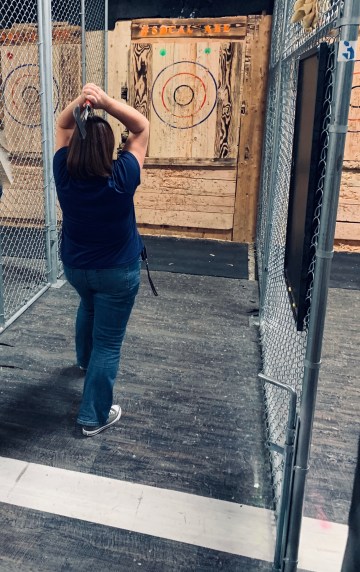
  • Throwing axes with my work friends (see picture below!)
  • Sky diving
  • Writing a book
  • Giving a commencement speech 
  • Studying abroad in Spain
  • Traveling to cities, states, and countries around the world
  • Reading about adventures I haven’t experience in person… yet!

I am proud of my adventurous spirit. I seek out friends and family who enjoy these experiences with me. I believe I have done more than extroverts out there in the world.  But because I’m an introvert, I am not shouting about these experiences from every rooftop or in every conversation.  You have to get to know me, or read this blog since this is how I reflect and share, to learn about my adventures.  But they are there.  Why do you think I named my book The Coach ADVenture?!

IMG_5212

What has been your favorite life adventure so far?

What is still on your life bucket list? 


Posted in reflection | Tagged , , , , , , , | 2 Comments

October Reading Update [2019]

My reading life goes through phases. Some months I’m into audiobooks every day in a row, and then I switch over to catch up on my favorite podcasts and I skip books for awhile. Some weeks I have many late nights at work or plans with friends and reading goes on the back burner, and then other weeks I find more time than I thought possible to read to my heart’s content. While I didn’t read a lot this month, I did hit 75 books read so far this year, which is fun to see in print! Plus my very own book, The Coach ADVenture, came out this month!

This month I read:

  • Harry Potter and the Cursed Child Parts One and Two by J.K.Rowling, John Tiffany & Jack Thorne – I’m going to London in December and my best friend bought us tickets to see this play over two nights while we are there.  I have loved the Harry Potter series since my father first introduced it to me. I loved taking time to dip back into the wizarding world with this new story. Reading it as a play was different than the novels, but it helped me visualize the play I will be seeing in a few months. I loved the adventurous storyline and cannot wait to see it performed live!
  • After the Flood by Kassandra Montag – What a fascinating book!  It was actually similar to The Age of Miracles by Karen Thompson Walker, which I read back in June. This book begins after a great six year flood that has left most of the world under water, with people surviving on ships and by creating communities on top of mountains. As in uncertain times, bad behavior makes it hard to trust anyone. Myra is just trying to keep herself and her daughter Pearl alive, as she fights to find her way back to her older daughter.  This story has family drama, issues around trust, community, secrets, and betrayal, as well as the climate concerns.  Ironically, while I was reading this, I attended a conference on green schools. Every time someone mentioned sustainability and oceans, I was freaked out, thinking about this book! It was a great read!
  • The Gifted School by Bruce Holsinger – I heard about this book on a 10 Things to Tell you podcast episode and I put it on hold at the library months ago. When it finally came up, I was excited to read it. I remember hearing it loosely compared to the recent college admission scandal with some celebrities, and it is part that, part overbearing parents, part obsession with keeping up with the Joneses, and part bad decision-making. I enjoyed liking and hating the characters throughout the story.  They each had redeemable qualities and also qualities that make you just despise them!
Posted in reflection | Tagged , , , | Leave a comment

Unsolicited Feedback

Have you ever received unsolicited feedback?  If you are a living, breathing human who interacts with real people (or internet trolls), I’m sure you have!  Recently a friend of my received some unsolicited feedback that was so rude it was shocking to her, and to me when she retold me the story.  It made me think about times I have received feedback that was unwanted.  This can happen for a variety of reasons.  Today I’m reflecting on this, because as an instructional coach I find giving relevant and purposeful feedback valuable, and a critical role of a coach.  However, if that feedback is unsolicited, it may not be well received.

Here are a few instances I can think of when unsolicited feedback was unnecessary:

  • As a principal, I once had a sassy Kindergarten student come up to me during her recess.  She looked me up and down and said, “That is the ugliest outfit I have ever seen.”  Now, I was both shocked and amused by this, coming from a 5 year old.  However, I contained my giggle and I used this as an opportunity to talk to her about speaking respectfully to people. [And to her credit, it was not one of my finer outfits!]
  • “You look tired.”  This statement is such an insult to me.  When someone says it, I assume that they mean I don’t look good. What they might mean, is that I don’t look like myself and they are concerned.  The truth is, I might be tired, or I might be battling an illness, or I might be going through a rough time, I might have stayed up late finishing a good book or binging a good show, or I might have decided to skip the make-up routine that morning.  No matter what, if it’s not a close friend showing genuine concern for me, this statement is a loaded insult. I recommend we avoid giving unsolicited feedback about looks in general, especially if it’s not so positive.
  • “Have you lost weight?” This may be controversial, but weight is another area where people often given unsolicited feedback.  As someone who has gained and lost the same X number of pounds many times over my lifetime, questions about weight, even when framed as a compliment, are triggering.  What do you say?  Yes, thanks for noticing.  No, I’m just wearing the right size pants today. Yes, but it’s a daily struggle and I’ve lost a lot before you finally noticed. No, I’m wearing 5 pair of Spanx and I’m sucking it all in. 
  • “What was going on in your classroom today?  It sounded out of control!”  Transitioning into education talk, this kind of feedback happens often in a school.  We walk by a colleague’s classroom, or we happen to share a wall with someone, so we make assumptions about what is going on inside without knowing all of the information.  On more than one occasion, someone heard noise coming from my classroom and expressed concern that I didn’t have control.  As a new teacher, I didn’t even know how to address this concern. My class wasn’t out of control. They were ENGAGED!  It wasn’t until I stepped out of my own classroom and began to visit other rooms that I realized how silent many of my peers’ classrooms were all day long.

All of these examples make me reflect on how important it is to provide SOLICITED feedback.  For instructional coaches, this is a learning process.  Each teacher you work with may prefer feedback in a different format.  And there are some teachers who don’t want feedback from you… yet! This is why I stress the importance of building trusting relationships before moving into a coaching role.  As you get to know a teacher, you can begin to see his or her strengths.  From there, you can begin to learn what his or her professional goals are and how you might support them. Coaching that involves observation and feedback can come next, especially when the teacher is asking you for feedback based on his or her goals.

I will add the caveat hear that as an administrator, there may come a time when you do have to give someone unsolicited feedback.  This may be following egregious behavior, or the endangerment of students.  That is your job and at that point, it is necessary whether the person wants the feedback or not.  However, the stronger your relationship is with that person prior to such an incident, the easier that difficult conversation will be for both of you.

What are your thoughts on feedback, both unsolicited and desired? 

For more information about instructional coaching, visit my webpage with dedicated resources supporting my book, The Coach ADVenture: Building Powerful Instructional Skills That Impact Learning.

TheCoachADventure_Cover_Front

Posted in Coaching | Tagged , , , , | 2 Comments

Building Resiliency: October

In January I began a deep dive in Elena Aguilar’s Onward: Cultivating Emotional Resilience in Educators and the accompanying workbook. I hope to share some of my reflections as I build daily habits to strength my own resilience and support that growth in others. Aguilar outlines a habit and a disposition for each month of the year. Follow along as I reflect on each month’s key ideas.

October’s habit is Be Here Now and the disposition is Humor.

October is the time of year when teachers begin to feel the pressure.  The beginning of the year routines have been established and the rigorous work has begun. Leaders are fielding parent complaints, scheduling evaluations, and completing all the paperwork that comes along. Aguilar knows the rhythm of a school year well, and she planned the habit and disposition for this month (and all of the months!) strategically. As I began to read this chapter, I needed a reminder of the value of mindfulness and I needed a kick to get back into a meditation habit.

Every time I dust off my favorite meditation app, Headspace, I enjoy it. Meditation is always time well spent, for peace of mind. I’ve tried to maintaining a morning meditation habit, but it’s not easy. This month, I’m working on building an evening meditation habit. Regardless of the time of day I do an official meditation, I also try to remind myself to stop and breath deeply a few times a day. It’s usually easy for me to remember this in my car. I spend a lot of time in my car, driving from school to school or home to work. While the traffic may stress me out, I arrive early to my destination 99.9% of the time, so I try to take a moment to take at least 3 deep breaths before I step out of my car and into the next meeting or activity.

“Practicing mindfulness is like hitting an internal pause button on the drama of life.” ~Page 127

This is so true! I recently participated in a 10 minute body scan meditation at a work meeting and when it was over I felt so incredibly calm, relaxed, and content. Whatever might have stressed me out before that meeting, I was able to into the rest of my day with such a sense of peace.

Ever since mindfulness was my word of 2015, I’ve cultivated a variety of habits to be more mindful in my life. I love Aguilar’s research on the history and benefits of mindfulness, and the links to why this is good for teachers and students too!  If the people with whom you work need some reasons to bring mindfulness into schools, this chapter is full of research to share with them.

“Our emotions are contagious… Children reflect the nervous systems of adults around them.” ~Page 133

I appreciate the link Aguilar makes in this chapter between mindfulness and implicit bias.  Until we are more aware of ourselves and our thoughts and actions, we cannot begin to address the implicit bias that lies within each of us. But bias is something that we need to address, especially in education, for the benefit of each student we serve.

The chapter ends on a happy note, asks us to reflect on moments of joy and humor. I love being able to pause and enjoy laughter with friends, family, or colleagues. Without the laughter, our work would be too much for any one of us to maintain alone.  It’s always a good reminder to make time for the joy!

Posts in the Building Resilience series:

Building Resilience

Posted in reflection | Tagged , , , , , | 3 Comments

Sustainability Education

What does sustainability education look like in your school system?

How green is your school/ district? 

I recently attended the Green California Schools and Community Colleges Summit. The job I began in July is in a school district that has been a leader in the Green Schools movement in California and the nation.  This is one of the many aspects of this district I was excited about during the application process. This is the first school district I have worked for that has clear goals about environmental stewardship within district systems and within the education of our students. I have spent the last three months learning about these systems and admiring the focus our district has on sustainability.

  • We have a district green team, and each school has a green team.
  • We have a district organic farm and all schools have gardens.
  • We use chemical-free cleaning.
  • Our classrooms have solar tubes to use more daylight efficiently.
  • We have high efficiency hand dryers.
  • We have hydration stations at each school.
  • We have waste diversion and food scrap composting.

I’m still learning about all of these elements. Attending this conference opened my eyes to even more! It also made me realize how important it is to share this information. When I think of all of the students across the country who aren’t learning this information, I’m worried. When I think of all of the systems that schools use that hinder sustainability efforts, I’m worried. When I think of what I didn’t know just four months ago about this, I’m worried about the educators who are where I was.

I learned a few tips I’d like to share for people at the beginning of this journey.

download

The U.N. 17 sustainable development goals (SDGs)

  1. The U.N. has 17 sustainable development goals “to transform our world”. You can read about the goals here and you can see them in the graphic above. This is a great place for educators to start educating themselves. It’s also a great way to involve students in the discussion. You could share the 17 goals with students and ask them to choose which goal they would like to have an impact on. This could lead to a student-driven passion project that could impact the world.

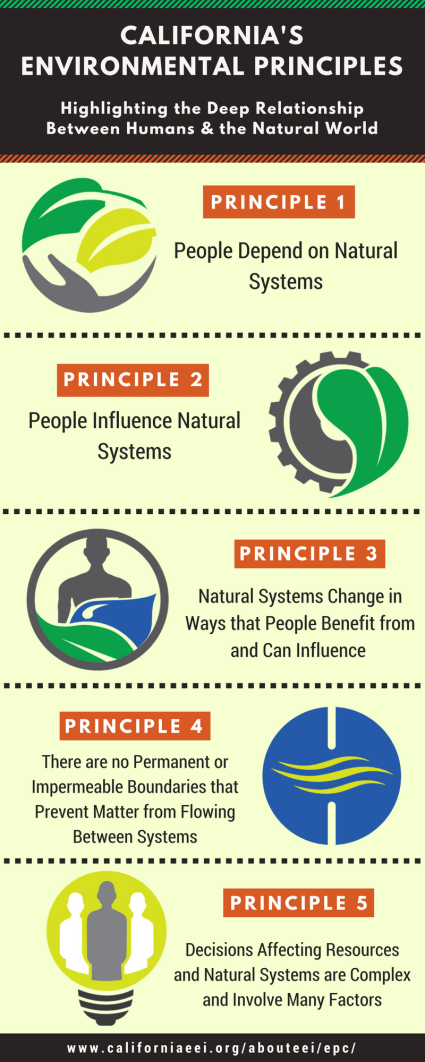
    infographic_californias-environmental-principles

    CA EP&C’s

  2. California has Environmental Principles and Concepts (EP & C’s). These are built into the latest History-Social Science and Science State Standards, and will be incorporated into VAPA, ELA, and more by 2022. These elements can be integrated within just about any class with some purposeful planning and new resources.
  3. One of the keynote speakers, and the former superintendent of my district, Dr. Tim Baird gave participants 3 ways to begin this work in a school or district:
    1. Green teams – Start a green team in your organization to talk and learn about this important work.
    2. Gardens – Build a garden on your campus. This can serve as an outdoor learning space, an addition to your school lunch program, and an education on how to make steps within your own community
    3. Garbage – Teach students how to do a garbage audit. Once they realize how much they throw out that will end up in a landfill, they will want to research other options. Soon they will be teaching others the value of recycling, composting, and using less single-use plastic.

What is your school or district doing in this area?  Where would you recommend people start?  If you are new to this, how might you begin this discussion in your system? 

Posted in Leadership | Tagged , , , , | 10 Comments