Building Resiliency: October

In January I began a deep dive in Elena Aguilar’s Onward: Cultivating Emotional Resilience in Educators and the accompanying workbook. I hope to share some of my reflections as I build daily habits to strength my own resilience and support that growth in others. Aguilar outlines a habit and a disposition for each month of the year. Follow along as I reflect on each month’s key ideas.

October’s habit is Be Here Now and the disposition is Humor.

October is the time of year when teachers begin to feel the pressure.  The beginning of the year routines have been established and the rigorous work has begun. Leaders are fielding parent complaints, scheduling evaluations, and completing all the paperwork that comes along. Aguilar knows the rhythm of a school year well, and she planned the habit and disposition for this month (and all of the months!) strategically. As I began to read this chapter, I needed a reminder of the value of mindfulness and I needed a kick to get back into a meditation habit.

Every time I dust off my favorite meditation app, Headspace, I enjoy it. Meditation is always time well spent, for peace of mind. I’ve tried to maintaining a morning meditation habit, but it’s not easy. This month, I’m working on building an evening meditation habit. Regardless of the time of day I do an official meditation, I also try to remind myself to stop and breath deeply a few times a day. It’s usually easy for me to remember this in my car. I spend a lot of time in my car, driving from school to school or home to work. While the traffic may stress me out, I arrive early to my destination 99.9% of the time, so I try to take a moment to take at least 3 deep breaths before I step out of my car and into the next meeting or activity.

“Practicing mindfulness is like hitting an internal pause button on the drama of life.” ~Page 127

This is so true! I recently participated in a 10 minute body scan meditation at a work meeting and when it was over I felt so incredibly calm, relaxed, and content. Whatever might have stressed me out before that meeting, I was able to into the rest of my day with such a sense of peace.

Ever since mindfulness was my word of 2015, I’ve cultivated a variety of habits to be more mindful in my life. I love Aguilar’s research on the history and benefits of mindfulness, and the links to why this is good for teachers and students too!  If the people with whom you work need some reasons to bring mindfulness into schools, this chapter is full of research to share with them.

“Our emotions are contagious… Children reflect the nervous systems of adults around them.” ~Page 133

I appreciate the link Aguilar makes in this chapter between mindfulness and implicit bias.  Until we are more aware of ourselves and our thoughts and actions, we cannot begin to address the implicit bias that lies within each of us. But bias is something that we need to address, especially in education, for the benefit of each student we serve.

The chapter ends on a happy note, asks us to reflect on moments of joy and humor. I love being able to pause and enjoy laughter with friends, family, or colleagues. Without the laughter, our work would be too much for any one of us to maintain alone.  It’s always a good reminder to make time for the joy!

Posts in the Building Resilience series:

Building Resilience

Posted in Reflection | Tagged , , , , , | 3 Comments

Sustainability Education

What does sustainability education look like in your school system?

How green is your school/ district? 

I recently attended the Green California Schools and Community Colleges Summit. The job I began in July is in a school district that has been a leader in the Green Schools movement in California and the nation.  This is one of the many aspects of this district I was excited about during the application process. This is the first school district I have worked for that has clear goals about environmental stewardship within district systems and within the education of our students. I have spent the last three months learning about these systems and admiring the focus our district has on sustainability.

  • We have a district green team, and each school has a green team.
  • We have a district organic farm and all schools have gardens.
  • We use chemical-free cleaning.
  • Our classrooms have solar tubes to use more daylight efficiently.
  • We have high efficiency hand dryers.
  • We have hydration stations at each school.
  • We have waste diversion and food scrap composting.

I’m still learning about all of these elements. Attending this conference opened my eyes to even more! It also made me realize how important it is to share this information. When I think of all of the students across the country who aren’t learning this information, I’m worried. When I think of all of the systems that schools use that hinder sustainability efforts, I’m worried. When I think of what I didn’t know just four months ago about this, I’m worried about the educators who are where I was.

I learned a few tips I’d like to share for people at the beginning of this journey.

download

The U.N. 17 sustainable development goals (SDGs)

  1. The U.N. has 17 sustainable development goals “to transform our world”. You can read about the goals here and you can see them in the graphic above. This is a great place for educators to start educating themselves. It’s also a great way to involve students in the discussion. You could share the 17 goals with students and ask them to choose which goal they would like to have an impact on. This could lead to a student-driven passion project that could impact the world.

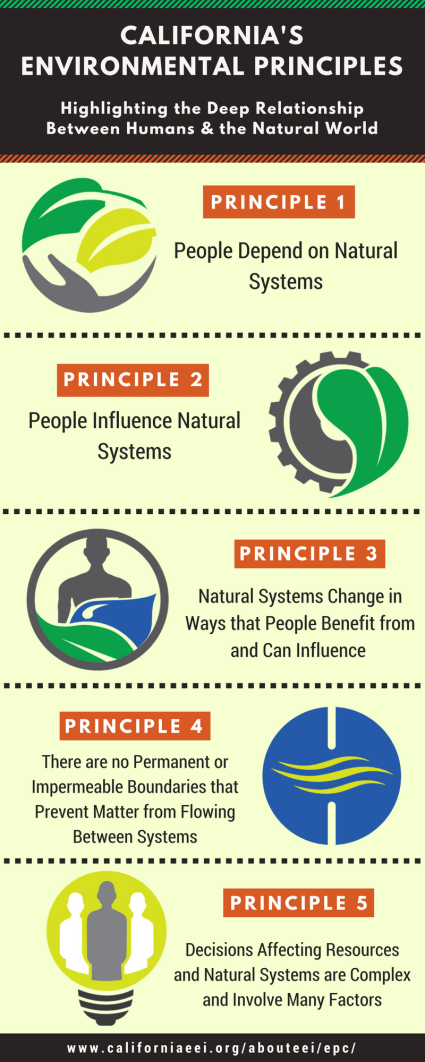
    infographic_californias-environmental-principles

    CA EP&C’s

  2. California has Environmental Principles and Concepts (EP & C’s). These are built into the latest History-Social Science and Science State Standards, and will be incorporated into VAPA, ELA, and more by 2022. These elements can be integrated within just about any class with some purposeful planning and new resources.
  3. One of the keynote speakers, and the former superintendent of my district, Dr. Tim Baird gave participants 3 ways to begin this work in a school or district:
    1. Green teams – Start a green team in your organization to talk and learn about this important work.
    2. Gardens – Build a garden on your campus. This can serve as an outdoor learning space, an addition to your school lunch program, and an education on how to make steps within your own community
    3. Garbage – Teach students how to do a garbage audit. Once they realize how much they throw out that will end up in a landfill, they will want to research other options. Soon they will be teaching others the value of recycling, composting, and using less single-use plastic.

What is your school or district doing in this area?  Where would you recommend people start?  If you are new to this, how might you begin this discussion in your system? 

Posted in Leadership | Tagged , , , , | 10 Comments

Observing lessons as an instructional coach

When I first became a coach, I was unsure what exactly I should write down during an observation. Over time, my coaching skills improved and I began to work with teachers on their own personal focus area. For instance, if a teacher asked me for help with engaging all students in the writing process, I would begin our coaching cycle by observing that teacher during a writing lesson. I would take note of what the teacher and the students said and did around writing, noting what was asked of the students and what they produced (or did not produce). These observational notes would help me talk to the teacher about next steps and would help me plan my demonstration lesson or our co-teaching lesson.

As an administrator, I learned how important it was for me to have a focus area before going out to observe in classrooms.  There are many things that can be observed in a classroom on any given day, but a coach cannot give a teacher feedback on all elements of teaching and learning at once. The more narrow your focus, the more the teacher can connect and reflect.

In Chapter 2, What are instructional leadership skills?, of my new book The Coach ADVenture: Building Powerful Instructional Leadership Skills that Impact Learning, I talk about three big areas in which you might focus your classroom observations.

Here is a small excerpt from the book…

Below is a list of possible instructional, environmental, and cultural items you might observe in a classroom:

INSTRUCTIONAL

  • Break down of minutes of teacher talk, student talk, and silence
  • Learning tasks—What are students actually saying or writing?
  • Daily objective/ learning target—What is stated or posted about the day’s learning?
  • Text—What text(s) are students seeing, using, reading, viewing?

ENVIRONMENTAL

  • Room setup—Students’ seating arrangement, teacher desk, other furniture, etc.
  • Print-rich—Are there books, posters, charts visible in the room?
  • Student work—Is there current student work visible in the room? Is the student work all identical or unique?

CULTURAL

  • Representative—Do the posters or pictures or books in the room reflect the culture of the students? Do they reflect diversity?
  • Risks—Do students feel comfortable taking risks?

 – – – – – – – – – – – – – – – – – – – – – – – – – – – – – – – – – – – – – – – – – – – – – – – – – – – – – – – – – – – – – – – – – – – – – – – –

On my website I have a page of resources to accompany the book. Included on that page are some sample note-taking guides that can support an instructional leader. Ideally, your note-taking guide should be based on your coaching goals with an individual teacher or your site focus areas. The more detailed notes a coach takes, the better the coaching conversation can be with a teacher. I know that when someone gives me feedback, I appreciate detailed, specific information with examples. In your role as coach, I encourage you to reflect on the following:

  • How do you take notes during an observation?
  • How do you decide what to focus on during an observation?
  • How do you use your notes to frame your coaching conversation?

You can see a preview of The Coach ADVenture on the DBC website here. If you are reading the book, I’d love to hear your thoughts using the hashtag #CoachADV on social media. TheCoachADventure_Cover_Front

Posted in Coaching | Tagged , , , , | 1 Comment

The Coach ADVenture is out!

I’m honored to share that my book came out today!  The Coach ADVenture: Building Powerful Instructional Leadership Skills that Impact Learning is meant to be a guide for all educators, in any role. Every educator can be a leader and an instructional coach, with the right skills.  The fun part of this book is that you can choose which ADVenture to follow.

TheCoachADventure_Cover_Front

There are two educator’s stories woven throughout the book.  Mr. Fox is an elementary principal with no instructional coaching skills when we first meet him.  Ms. Martinez is a high school principal with a wealth of instructional leadership experience and a challenging team to lead.  Each of their coaching ADVentures follows a different path through the book.  You can join either of them on their journey or you can read from front to back as you enhance your own skill set.

I cannot wait for educators to read this book and put the ideas into practice because I truly believe that students and staff will be positively impacted.  If you read the book, or if you want to hear about the book, please join our community using the #CoachADV hashtag to share successes, challenges, and support.  Consider visiting my website for additional coaching resources. I look forward to interacting with our coaching community as we learn and grow together.

The Coach ADVenture: Building Powerful Instructional Leadership Skills that Impact Learning is available for purchase on Amazon and Barnes & Noble.


Posted in Coaching | Tagged , , , , , , , | 7 Comments

September Reading Update [2019]

As of the end of this month, I have read 71 books this year.  That is more than I read in all of 2018,  2017, or 2015, and two more than I read in 2016. I keep track of these books for my own memory and to compete with myself as a reader. I’m proud that 2019 will be the year I’ve read the most books in the last five years. This month I read:

  • The Friends We Keep by Jane Green – I love Green’s romantic comedy style of writing.  She usually creates characters who are both lovable and realistically flawed, and Topher, Maggie, and Evvie were no exception. These three meet in college in England and become best friends, then part to live their own lives for 30 years, and then reunite in a bittersweet way. I liked the ease of this story and it made me want to live in an old English manor!
  • Firefly Lane by Kristin Hannah – After I wrote about loving Nightingale last month, this earlier book by the same author was recommended to me (thanks Andree!). I loved this long, epic story of best friends. Tully and Kate are opposites in so many ways, but their friendship provides them each exactly what they need when they meet as young girls. At times, I was reminded of some of my best girl friends and the fun we had during our closest moments. As they grew up, I was reminded of the two best friends in Beaches. Tully, in the pinnacle of her fame, reminded me of Bette Midler’s selfish character and her famous line, “Enough about me. Let’s talk about you. What do you think of me?” This story was sweet and funny and sad and beautiful.
  • Learner-Centered Innovation: Spark Curiosity, Ignite Passion and Unleash Genius by Katie Martin – I’ve had this book on my to-be-read pile ever since it was published. Not only do I love the DBC book family and the connection to The Innovator’s Mindset, but I know and respect Katie and her work. There is so much to learn and love about this book! I appreciate Katie’s focus on making learning more student-driven and relevant, something we aren’t always so good at in traditional school.  I also appreciate Katie’s lessons about professional development for teachers, and ways to make that experience more meaningful and impactful. There were so many lines/ passages I noted and want to return to.  Here are just a few:
    • A twist on traditional evaluation – Have evaluatee write a 3-2-Q Reflection:  3 successes, 2 areas they want to improve, and a question they have for further inquiry or growth
    • “We can change policies and implement new programs, but if we don’t empower teachers and create school cultures where people feel valued and free to take risks, we will miss out on our greatest opportunity to change how students learn.”
    • “When we give people control to make decisions that impact their work, they begin to take risks and trust themselves and most often will exceed expectations.”
    • “Do you see me? Do you know me? Will you grow me?”
  • An American Marriage by Tayari Jones – This was such a bittersweet story. Celestial and Roy have a turbulent and loving relationship that changes dramatically once he is wrongfully imprisoned for a crime he did not commit. I didn’t get into this story right away because the beginning was written in such a cryptic way.  The author jumped across decades from one sentence to another, fast-forwarding the details to get to the first big event. The writing style threw me off for awhile, but then I was invested in the characters and wanted to know what would happen. I think it ended exactly as it wold have in real life.
  • Imagine Us Happy by Jennifer Yu [audiobook] – This was an angsty YA novel that had me annoyed more than anything else. The main character, Stella, suffers from some mental health issues, and narrates all of her thoughts and emotions while saying and doing what people expect of her. For me reading this as an adult, I wished for a little more details about how she copes with her anxiety and a little less boy-girl and friend drama. Throughout most of the novel, I was thinking that I wouldn’t want any teenagers to actually read this, because there were so many bad examples in Stella’s actions, or lack of action. The ending had some some nice lessons, but it was hard getting there.  It was interesting that the author told the story out of order, literally going from chapter 12 to 48 to 3, etc. I think it was sold as “If you liked 500 Days of Summer…” which is why I originally decided to listen to this book at all.
  • A Delicate Touch by Stuart Woods – I had a low-key weekend where I was fighting off a cold (when everyone around me was getting the flue and/or pneumonia) so I reached for one of my favorite mystery writer’s for comfort.  This was an easy read, where Stone Barrington did was he always does – meets a pretty woman, gets himself into some danger, flies off around the world to escape the danger while trying to beat the bad guys, saves the day with his friends, and returns unarmed.
  • Recursion by Blake Crouch – This book was recommended by Laura Tremaine on my favorite new podcast, 10 Things to Tell You. As an avid reader, Laura has done a few episodes recapping her favorite reads and this was on the list and by her description I knew I wanted to read it. This is a mystery/ sci fi book about memory and time. I don’t want to say more and give anything away, in case you plan to read it. It’s an interesting and scary look into an alternate reality. It was fast-paced (after the first few chapters) and I loved it!
  • I’ll Be There For You: The One about Friends by Kelsey Miller [audiobook] – Before I tell you about this book, I must admit that I did not enjoy the reading of it on this audio version.  The reader attempted to make her voice different when she read quotes by other people, but her fake accents were bad, making me hate her voice. The book, itself, was interesting. As an avid fan of the TV show Friends, I was excited when I heard about this book. I wasn’t sure what to expect exactly.  The author takes us through the casting of the show, the backstory of the creators, key points of each season, and a lot about the negotiations that led up to their famous salaries.  She also addresses the concerns that come up about Friends – how it was a show with no diversity, not actually representing NYC accurately, and how there were homophobic and misogynistic comments littered throughout the pithy dialogue.  When Friends first came out, these were not glaring issues for many because it was a different time and we weren’t talking about that in many places yet. It was hard for me to hear some of the harsher criticism the author quoted throughout this book, but it made me reflect on what I loved about the show, how different my life was from 1994-2004, and how I hope I would notice these errors today. After all that, this still makes me want to go back and rewatch the entire series for the good parts – good friends who are your family, getting you through the good and bad of life.
  • Big Girl: How I Gave up Dieting & Got a Life by Kelsey Miller – After finishing the one about Friends, I saw that the author had written a very different book – a memoir about her journey to Intuitive Eating. I appreciated her honest, self-depracating, detailed storytelling of past and current challenges related to food, dieting, weight, exercise, and trying to be a normal healthy person in today’s society. I’ve begun to read around the edges of Intuitive Eating and this book inspired me to go deeper in my reading and discovery.
Posted in Reflection | Tagged , , , | Leave a comment

Building Resiliency: September

In January 2019 I began a deep dive in Elena Aguilar’s Onward: Cultivating Emotional Resilience in Educators and the accompanying workbook. I hope to share some of my reflections as I build daily habits to strength my own resilience and support that growth in others. Aguilar outlines a habit and a disposition for each month of the year. Follow along as I reflect on each month’s key ideas.

September’s habit is Build Community and the disposition is Empathy.

Aguilar begins this chapter sharing research about why humans need connections, relationships, and community. From her personal stories to decades of research, she reminds me about the value of surrounding yourself with people you can trust. In every job I’ve had, I’ve made some close, personal friendships that I value. I’ve also made a lot of acquaintances, and I’ve worked with people where the only thing we had in common was our shared work. But I’m also driven to find a deeper connection, and to stay in contact with those who have similar values to me, and those who push my thinking farther.

Aguilar reminds us that as leaders, it is our job to ensure that our school systems have support structures in place to welcome new staff and to create opportunities for relationship and community-building to take place early on. I think this is also true when we hire veteran staff to new positions. How we “onboard” staff says a lot about our organization’s culture. Is there a clear process? Is the process about paperwork only or also about learning the people and the work? How do we offer mentoring for people in new roles?

“Student learning is impacted by the amount of relational trust among adults” (p. 101)

Trust is critical to building community. So often when I see significant conflicts arise, it seems that trust wasn’t present or was broken.

“Put the brakes on your interpretations of others. Refrain from drawing quick conclusions about someone else’s message or emotions. Create space between your observation and your assumptions.” (p. 110)

Aguilar says this in relation to body language and communication when forming community. I just wrote about assumptions in a recent blog post, challenging myself not to jump to assumptions without information. Assumptions can create misunderstandings and can delay forming trusting relationships.

Cultural competence and implicit bias are areas that we need to continue to talk more about in education (and in today’s society as a whole). By understanding and appreciating people from other cultures, we begin to form diverse communities. But we must also recognize that everyone has implicit bias. It’s up to each of us to do the hard, reflective, internal work to identify our own biases and how they might be leading us to false assumptions.

As Aguilar goes deeper into what can make or break a community she brings up the idea of fear. I often find that fear shows up in different ways in education, and it can negatively impact so much of our work.  When a new initiative begins, people are often fearful that they will fail, fearful that the work will be too hard or too much, fearful that others will judge their first attempts, or fearful that their students will not be successful. This fear can show up as refusal to participate, lack of buy-in, unwillingness to attend or participate, or general apathy. As leaders, we need to recognize the signs of fear and find ways to support people through new learning.

The disposition of empathy can help us build community. By getting to know one another, to truly related to where we have been and what we are going through, we can support one another in good and bad times. I know I always feel better when someone shows me empathy and I feel just as good when I am able to show someone else empathy. In places where I feel less of a sense of community, like my own personal neighborhood, I’m going to work harder to demonstrate empathy with my neighbors.


Posts in the Building Resilience series:

Building Resilience

Posted in Reflection | Tagged , , , , | 3 Comments

What are you assuming?

My new favorite blog inspiration, the podcast 10 Things to Tell You, talked all about the assumptions we make about others. The podcast episode talked about the many ways we make assumptions about others throughout our day. If someone in front of me doesn’t hold the door open for me, I could assume he is a jerk and not a gentleman, or I could assume that he is having a bad day or that he didn’t see me or that I have no idea what is going on in his life.

I’ve written about presuming positive intentions before, especially in education. This idea is worth revisiting because I think during stressful situations or disagreements, we often fall back on our own assumptions. Since I started a new job just two months ago, I have worked hard to get to know people authentically, and not to make any snap judgements based on assumptions. One strategy that has helped with this has been many face-to-face meetings. When in doubt, I find it’s better to meet in person, or at least over a phone call, then to try to understand someone’s perspective through texts or emails. I find that in the written word is where I often make the most assumptions about others.

The one other place I find myself making the most assumptions is about complete strangers in public. When I see someone do something I would never do, or act in a way that seems shocking, I make a lot of assumptions in my mind. I have enough self control not to say most of the things I think, unless I’m with one of my best friends who can practically read my mind, but the thoughts are still there. As I reflect, I realize that my assumptions are often based on my own biases or lack of understanding. My hope is that I can catch myself as these thoughts first arise in my mind, and take a moment to step back and pause before making any more assumptions about someone I do not know.

What role do assumptions play in your life? 


Posted in Reflection | Tagged , , | 2 Comments

Shining Out of My Comfort Zone

A few months ago, a friend from my doctoral program reached out to me and asked if I would consider being the keynote speaker for her university’s commencement ceremony.  This is a small, private university but still I hesitated.  I was nervous. Although I love facilitating professional development, I am not a natural speaker and I get nervous having to prepare anything more than a few minutes of talking in a room full of strangers. But then I remembered my word of 2019…

SHINE 2019

One of the reasons SHINE became my word this year was to motivate me to step out of my comfort zone and to try new things, especially professionally. So after my initial hesitation I committed to my friend to be the keynote speaker.

The commencement ceremony was this weekend and I’m so glad I made myself try this new thing. Over the last few weeks I worked on my speech, crafting a story that was personal and that also had a message for new graduates. I talked about passion, purpose, and people. I am proud of myself and just wanted to take a moment to reflect on why I even hesitated, because there are some leadership and learning implications.

  • Sometimes we don’t try something because we think we aren’t good enough, or don’t have anything to offer. I often see this when people are scared to contribute on social media, believing that they don’t have anything worth sharing. But you never know when your work will be the exact inspiration someone else needs.
  • Sometimes we let fear take over. I am a proud introvert and I know what fuels me and what drains me. However, sometimes I use my introvert status as an excuse to avoid something that feels uncomfortable. How often is that true for new learning challenges? When someone has a learning setback, they often use it as excuse to give up, instead of to persevere. Ironically, I also spoke about fixed versus growth mindset in my speech!
  • Sometimes we just don’t want to work hard at yet another thing. One of my first thoughts when asked, was to say no just because I didn’t want to give up a free Saturday. And if I had known then how busy the three weeks leading up to the event were going to be, I probably would have said no! I quoted Simon Sinek in my speech saying, “Working hard for something we don’t care about is called stress. Working hard for something we love is called passion.” At first, the request to do this felt like stress. But when I realized I had something worthwhile to share, about lessons I’ve learned and what I love about my own journey, it became a passion. 

I’m writing this more for myself than anyone else – to remind myself to not let any of these sometimes trip me up in the future. I’m writing this happy that SHINE continues to find it’s way into my life throughout this year.

How does your word of the year show up for you?

What does stepping out of your comfort zone look like for you? 

Posted in Reflection | Tagged , , , , | 2 Comments

Where do you live?

I love writing and I use blogging and journaling as reflection tools. I recently discovered a new-to-me podcast, 10 Things to Tell You, and I am loving everything about it! Laura, the host, prompted my post about when and what I read and she has prompted this reflection as well. In her episode about where she lives, she shared ten things she loves about living in LA. I decided to share 5 things that make me love living in San Diego and 5 things that I’m loving about working in Encinitas, which is in north San Diego County and where I began working on July 1st.

  1. I love the weather in San Diego… most of the time!  I moved here because I believed it was 72* and sunny year-round, with no rain, no bugs, and no humidity.  I swear my first year this was all true. But now that I have been here 20 years (wow!) I can admit that the weather is not always perfect. We “suffer” through May Grey, June Gloom, and fire season fall. But I will take all of that and our winters any day over east coast weather.
  2. I love the opportunities to be outdoors in San Diego.  Many restaurants offer outdoor seating year-round, the malls are outdoors, and since we have to drive everywhere, there is so much to see. I also love that the weather and the opportunities make me more active than I would be somewhere else. I love walking on the beach after work, meeting a friend at the bay for a weekend walk, and making time to enjoy a hike or just a day at the zoo.
  3. I love Farmer’s Markets! We have farmer’s markets across San Diego County every day of the week.  I feel hypocritical writing this, however, because I haven’t been to one in awhile. But I enjoy the options and whenever I go, I’m glad I did.
  4. I like the pace of Southern California.  In general, people here are laid back and they move with less of a hurry than what I remember from the East Coast.  But I’m still a Jersey Girl at heart, so I’m still walking and talking faster than most here! I think the overall pace slows me down so I’m not going at warp speed all of the time.
  5. I love that so many of my family members live in California!  When I moved here 20 years ago, none of my immediate family was here, and I didn’t see my extended family much.  But since that time, my father and brother have moved out here, we have inherited a great stepmom and her extended family, and I’ve gotten closer to my extended family scattered around CA. Not everyone I love is here, but I’m happy that so many are.
  6. I love that the city of Encinitas is so GREEN.  By green, I don’t mean trees, although I was surprised by the amount of beautiful tree-lined streets around our school neighborhoods. I mean environmentally conscious. My metal straw, glass water bottles, and canvas grocery bags fit right in. All of our schools teach students how to separate waste for different purposes and have water hydration stations. Our students are growing up in a city where it is not optional to recycle and to take care of the community around us now and for the future.
  7. I love the Encinitas coast line. It’s so interesting to visit the various beach areas because they are each unique. We have big cliffs, houses up high on the bluffs, then wide sandy beaches half a mile down the road. There are some beaches only accessible by steep hills and down the road you can park right next to a beach. The Coaster drives right by the beach multiple times a day. And a few of our schools have great beach views!
  8. Encinitas is full of cute neighborhoods. There are technically five distinct areas within Encinitas, but even more diverse smaller communities. As I drive around our district, and to find walking paths after work, I continually discover fun new vistas!
  9. The people of Encinitas are so warm and welcoming! Many people have lived in Encinitas all their lives, and the adults I meet also attended our elementary schools growing up. But the community welcomes everyone – old and new – and you feel like people are truly happy you are there.
  10. Encinitas is a true beach town. Growing up, we would vacation at the Jersey Shore (which is our beach) every summer. There are parts of the Encinitas culture that remind me of my childhood summers and love of the beach life.
IMG_4906

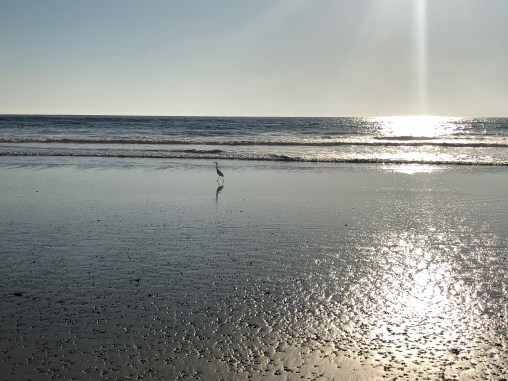
The Pacific

I’d love to hear about where you live and what you love about it.

Posted in Reflection | Tagged , , , | Leave a comment

August Reading Update [2019]

At the end of each month, I love to look back on these posts to see what I read. This month’s post makes me a little sad because I didn’t read much at all.  However, this was the second month of my new job, and the first two weeks of a new school year.  I have been very busy, and way too tired to read after long work days.

  • Dear Adam: The Pen Pal Romance Series by Kelsie Stelting [audiobook] – I loved this fun YA story. The chapters were narrated by two main characters, Nora and Emerick. As we learned about their lives in high school, an anonymous student starts an advice column in the school paper. Over time, all of the students learn that everyone has problems and that no one is immune to family or friend or school drama.
  • The Nightingale by Kristin Hannah [half read/ half audiobook] – I LOVED this book!  Every time I hear about another WWII novel, I think that we have enough and we don’t need more.  But then I read one like this and I’m so glad we have this one too! This was such a touching story of two sisters and how they survived the war in France. Isabelle created a secret and dangerous way to save British and American pilots who landed in enemy territory.  Her sister Vianne had Nazi’s staying in her home, while her husband was a POW, and her best friend was targeted for being Jewish.  Both women were brave in their own ways. There was a lot of sadness mixed with moments of triumphs.
  • The Sumer We Lost Her by Tish Cohen – I finished this book just in time to make it on this month’s post. I enjoyed this bittersweet story, about a trouble marriage, a missing girl, and a past coming back to haunt them. Elise and Matt were both flawed characters, trying to decide whether to fight for their marriage or not. The chapters gave us both of their perspectives and I didn’t end up loving either of them, but I grew to appreciate what they brought to their relationship. The nature and the nostalgia were beautiful to read throughout the book.
Posted in Reflection | Tagged , , , | 1 Comment