I Want to Hold Your Hand

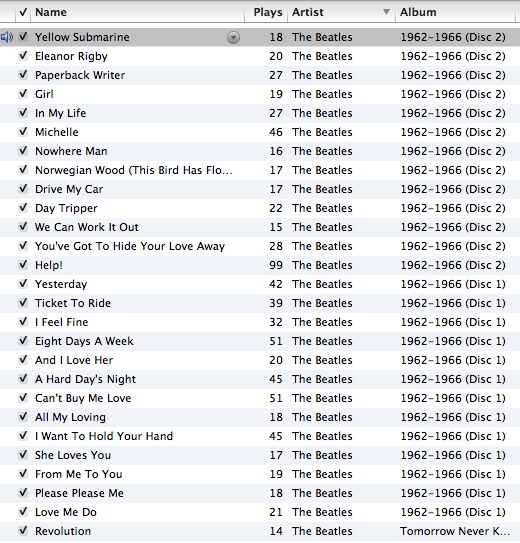
As I drove home from a nice visit with my father (Hi Dad!), on the weekend that is the 50th anniversary of the Beatles arrival in the U.S., I sang every word to every Beatles song I own. Literally. Every. Word.

Beatles songs

How is this possible, you ask. Well, my parents get most of the credit! Every road trip we took during my childhood (and we took a lot!), we listened to my parents’ music until it became our music. My brother and I are huge fans of much of the music of the 50’s and 60’s, which always made our parents proud. In fact, my father, brother and I exchanged group texts about the Beatles tonight, sharing which special we might watch and what we were listening to!

But it’s not just those decades. I know all the words to MANY songs from a wide variety of years. How? How does my brain retain all those words and melodies when I can’t remember any date I ever had to memorize in a history class? And it’s not just music. I know the words to certain poems, stories, and texts that I’ve loved over the years. Of course, my favorite line from A Midsummer Night’s Dream was memorized by watching Dead Poets Society over and over again!

So why do music and poetry lyrics come so easily to me? Why are those the words I remember? The things I never learned in school, but in other learning experiences…

This all makes me wonder about a typical school’s definition of learning. What are we doing to tap into the passions and interests of our students? In what ways are we sharing our passions with our students? How are we redefining learning to address multiple learning styles and modalities? What will our students know and use in 30 years that they learned with us?

And will I still know all these lyrics in 30 more years?!

What is your favorite Beatles song?!

Posted in Learning | Tagged , , , , , | 2 Comments

[Abecedary of Reflection] Failure

F: Failure

CCC work by 123rf.com

CCC work by 123rf.com

Such a negative word.

So often teachers live in fear of failure. Failing our students, failing administrator’s evaluations, failing the state or the federal government’s requirements. Feeling like a failure.

Students do everything in their power to impress us and avoid failure.

But what is failure really? I believe that failure provides us with opportunities to learn and improve. I feel that if we redefined failure, we would give ourselves the chance to become more reflective about our practice and more willing to start over again.

As I have worked on this post and reflected on my thoughts about failure, I came across this article on ASCD about changing our perspective on failure in the classroom. This article and my reflections on failure remind me of an experience with my mom at the beach one summer day. My mom and I were watching a dad play with his three young children- running in and out of the ocean, building sand castles, and having a great time. When one of the kids fell down, the father reacted by smiling and saying something like, “Okay, let’s try again!”. The child smiled and hopped up, ready to play some more. My mom and discussed how we often observed mothers react by saying, “Oh no, are you okay?” which led to a child crying and feeling sad or upset, as if they had failed and could not fix their mistake. This example isn’t meant to be a lesson in parenting (or even a commentary on the different styles of men and women!), but to help us reflect on our attitudes and beliefs about failure.

I recently created a board on Pinterest called “Learning from Mistakes” to go along with a source set I was creating to fit the theme of “If at first you don’t succeed…”. The pins on this board are examples of the lessons we can take from failures. To me, this is all part of a journey of learning- we are all working to become “our next best selves,” as one of my professor recently said.

Reflective questions to consider:

  • How can your mistakes, or failures, help you become better tomorrow than you were yesterday?
  • How can we change the definition of failure for students in schools?  What about for teachers?
  • What have you succeeded at, after an initial failure?
  • How can redefining failure develop a growth mindset?

Abecedary of Reflection:

Posted in Reflection | Tagged , , , , , | 6 Comments

[Mentor Text Monday] Byrd Baylor

For today’s mentor text I’m going to share two of my favorite picture books by Byrd Baylor, illustrated by Peter Parnall.

The-Table-Where-Rich-People-Sit-Baylor-Byrd-9780689820083 byrd_baylor_2

Not only are both of these books incredibly sweet stories with beautiful illustrations, but they lend themselves to an author’s craft study of poetry. Baylor’s stories are told through free verse poetry. Often, each sentence is its own paragraph or stanza on the page. The minimal dialogue that is included is often poignant and so purposeful to the story. Students could study one page, noting how and when the author chose to create new paragraphs/ stanzas, discussing why those choices were important to the story.

Baylor’s writing could also be used as a mentor text to study author’s use of parentheses. In both of these books, Baylor uses parentheses as a way to show the narrator’s thoughts throughout the story. These inner thoughts allow the reader to better understand the narrator and her perspective, making it even more personal.

” Otherwise, I count it just an average day.  (I told you I was choosy.)” – I’m in Charge of Celebrations, Byrd, 1986.

Have you read any of Byrd Baylor’s books?  Have your students used any of her writings as mentor texts?

Previous Mentor Text posts:

Percy Jackson

Love That Dog

Divergent Dashes

The Mysteries of Harris Burdick

This is Not My Hat

Posted in Mentor Text Monday | Tagged , , , , , | Leave a comment

Things I’m Loving Friday

Many of the healthy living bloggers I follow often post weekly editions of things they are loving. You can see examples of their posts here and here. I thought I would try it out, with a leadership and learning spin to it.

Things I’m Loving Right Now:

  • Elena Aguilar’s resources – I can’t compliment this coach, writer, and leader enough! I’ve already written about her book, The Art of Coaching, which I am using as a book study with the coaches in my district. In addition to her book, her website and blog are additional resources that I use on a regular basis. Sometimes I go searching for a specific support, like a protocol for discussing a text, and I find it.  Other times I just explore and I find amazing ideas I didn’t even know I needed! From her website/ book I recently rediscovered this great resource…
  • National School Reform Faculty– This is an amazing resource for professional development. You can find protocols, guides on facilitation, articles, professional readings, etc., to support your work with adult learners. I recently used the Three Levels of Text Protocol and it supported amazing, reflective conversations where coaches were able to connect their specific work to the text we were discussing (Aguilar’s, of course!).
  • Outlook calendars – This may seem odd, but let me explain! At work we all have Outlook and access to see anyone’s calendar. This makes it so easy to schedule meetings with groups of people. It also makes it convenient to know whether or not someone truly “has a minute” if you happen to drop by their office at a certain time.  Since I schedule a lot of team meetings, site visits, and other collaborations, AND since I am insanely organized when it comes to my own calendar and schedule, I appreciate this tool.
  • Blogs! – I have written this blog for a year and a half now and have read leadership and learning blogs even longer than that. But lately I have found a renewed passion for my own writing and new joy in reading the work of others. I think, like so many things in our lives, when we get busy we have to prioritize.  Finding the purpose in what we do with our time matters. When I have a purpose for reading or writing blogs, I enjoy them even more. My purposes for my writing are about reflecting on my own journey and my desire to share that publicly and to connect more with my colleagues near and far. My reading purposes have shifted to not just learning about good ideas, but reading as a writer for blog inspirations, and also reading as a curator. I send a weekly update to my coaches and I enjoy sharing relevant resources with them.

What are you loving right now?

What helps or inspires you as a leader and a learner?

What blogs are you loving?

Posted in Leadership | Tagged , , , , , , , , , , | 10 Comments

[Abecedary of Reflection] Expectations

E: Expectations

What do you think of when you hear the word expectations? Does it bring to mind a positive or negative connotation? Do you hold yourself to high expectations? Do others hold you to high expectations? I know from some conversations with a good friend during my most stressful times that I hold myself to expectations higher than I would ever consider for others.

CCC work by oliviasplus.com

CCC work by oliviasplus.com

I have also had many conversations with colleagues across the nation (both in person and through twitter) about the low expectations some educators have for certain populations of learners. The more I read about cultural proficiency in my current class, the more I realize that expectations are often linked to our knowledge of our own culture and lack of knowledge of the culture of those we serve. I seek to become a more culturally proficient leader in the hopes of opening more hearts of educators in order to better serve ALL learners. Social Justice Leadership (another topic within my current cultural proficiency class) is all about high expectations (in the form of equity and access) for ALL.

Looking at expectations from a different angle, think for a minute about a leader preparing for a classroom observation of a teacher on an improvement/ remediation plan. Does that leader walk into the classroom with expectations for the teaching and learning she will observe? Think about a group of teachers scoring student work products. Does someone say, “Oh, here is John’s paper. I already know this must be a one because he is one of my low kids.”  [Side note- this is one of those moments I was thinking of when reflecting on dissonance.  I would respond to a comment like this if I were present.]

“We expect to get more of what we already see, and we usually can only see that which we already expect. That is why it is so difficult to move away from a perspective once it’s established.” (p. 29)

– Leading Every Day: 124 Actions for Effective Leadership by Joyce Kaser, Susan Mundry, Katherine E. Stiles, and Susan Loucks-Horsley

Thinking about the quote above, what expectations do you bring to your work everyday? Are your expectations helping or hindering you from making progress as a leader? The more I reflect on my own expectations, the more I want to work on:

  • holding myself to reasonable expectations.
  • putting aside my expectations when they give me negative pre-conceived notions about a situation.
  • supporting my work and the work of those with whom I work to ensure that our decisions are based on holding our students and teachers to high expectations.
 Reflective questions to consider:
  • How do your expectations support your work?
  • Do you have any expectations that do not support your work?
  • Does your system/ organization have high expectations for the students and staff?

Abecedary of Reflection:

Posted in Reflection | Tagged , , , , , , | 3 Comments

[Mentor Text Monday] This is Not My Hat

Today I would like to discuss a mentor text idea using the incredibly creative This is Not My Hat by Jon Klassen.

0763655996

First of all, if you have not yet read this book, go read it immediately! It is one of my favorite picture books!

With students of just about any age, I would use this as a mentor text to demonstrate how important pictures can be to storytelling. The entire story of This is Not My Hat is told partly in words and partly in pictures. If you don’t “read” the pictures along with the words, you might miss the inferences the author expects you to make throughout the story, leading to the final inference at the end.

Another author’s craft element demonstrated by this book is the concept of “show not tell” that is often hard for young readers to accomplish. This is a short picture book with one or two sentences per page, along with a picture. The final three pages only have pictures- no words. The author’s strategic use of both words and pictures help to tell the story concisely and humorously.

Have you used this, or other Klassen picture books, as mentor texts?

Previous Mentor Text posts:

Percy Jackson

Love That Dog

Divergent Dashes

The Mysteries of Harris Burdick

Posted in Mentor Text Monday | Tagged , , , , , | 3 Comments

[Abecedary of Reflection] Dissonance

D: Dissonance

Merriam-Webster defines dissonance as:  lack of agreement; especially : inconsistency between the beliefs one holds or between one’s actions and one’s beliefs 

The example in the dictionary even references cognitive dissonance, which I considered for my “c” in this reflective alphabet. The reasons I did not use this phrase for “c” was that cognitive was not the word that I wanted to connect to reflection- dissonance was.

Licensed under CC By Chrizizhod (Own work) [GFDL (http://www.gnu.org/copyleft/fdl.html) or CC-BY-SA-3.0-2.5-2.0-1.0 (http://creativecommons.org/licenses/by-sa/3.0)], via Wikimedia Commons

Licensed under CC By Chrizizhod

In Leading Every Day: 124 Actions for Effective Leadership, the authors define cognitive dissonance as “a disruption in someone’s thinking, causing them to struggle to make sense of something that doesn’t ft with their current ideas” (Kaser, Mundry, Stiles & Loucks-Horsely, 2006, p. 154). They go on to explain that cognitive dissonance can lead to “transformative learning”

So often in my professional life I observe colleagues struggle with dissonance- lack of agreement between team members in Professional Learning Communities (PLCs), inconsistencies between personal beliefs and those of the school, district, state, or other external organizations, or the struggle that comes when someone begins to learn new ideas that conflict with ideas one has previously held fast to. The minute an idea is challenged or even questioned, I see people shutting down. We have become so defensive of our overly-attacked profession that the mere act of questioning fosters the need to defend all without taking the time to listen and consider different ideas.  

We see this with our students too. When the going gets tough, many students stop trying and wait for the teacher to give them the answer… and it usually works out just fine for them. But if we want our students to change, our teaching must change. And if we want our teachers to change, we, the leaders, must address dissonance as it surfaces.

Dissonance can lead to amazing breakthroughs. But we have to get comfortable with the discomfort. One of my colleagues likes to call it the “frown face” look. When we are leading professional development workshops or facilitating team meetings, we start to see the “frown face” when someone begins to experience dissonance- personally, professionally, individually, or collaboratively. As leaders, we have begun to address the face and name the feeling. Rather than allow a meeting to get side tracked by excuses, we bring participants back to the present to consider that with which they are struggling. The more time we provide for people to reflect on the dissonance, the more likely we are to see change- or to come out on the other side stronger for having had a rich discussion.

We don’t always have to agree. We won’t always convince people to change their minds. I believe it is most important to acknowledge our lack of agreement publicly and professionally in order to make strides towards a truly functional Professional Learning Community/ Network.

Questions to consider as you reflect:

  • When did you last experience dissonance?
  • What have you done (or heard done) in response to dissonance in a tension-filled meeting?

Abecedary of Reflection:

Posted in Reflection | Tagged , , , , , , | 4 Comments

[Abecedary of Reflection] Change and Celebration

C: Change & Celebration

Choosing a word for c was hard for me. So many words came to mind when I first began to brainstorm this idea. I thought of communication and collaboration and change, then got stuck on the concept of cognitive dissonance (expect to see this pop up again!). Then I decided to ask my twitter PLN what words came to my when they thought of reflection. Some of the “c” words they suggested:

  • changing, celebrating successes – @jenmarten
  • consider, celebrate – @JamieArmin
  • change, celebration – @lisadcelaya
  • clarity – @KathleenDiver

It was interesting to me that both change and celebration came up multiple times. It seemed important to reflect on both of these words.

When I think about reflection, so often change is involved. Either I am overly stressed and haven’t taken the time to reflect as much as I should during an important time of change, or I find myself gravitating to my reflective practices (writing, walking, communicating with friends and colleagues) more than normal as I become engrossed in major change. I cannot tell you how many times I’ve written about how I need to make time to write and reflect during times of stress, usually after I’m already in the midst of that stress! For me, reflection helps calm my stress and support me during times of change. I actually enjoy change in my professional life but not as much in my personal life.  


Strength

You might think that celebration and change do not have much in common. However, when I think about these two words to the concept of reflection, I see many connections. An important aspect of reflection is taking time to celebrate- celebrate successes, acknowledge challenges, and celebrate the continued journey. So often leaders forget to celebrate the good things (#eduwins!) that happen day-to-day because we become engrossed in the challenges still before us. There will always be challenges. But those seem less daunting when we take time to reflect on all that we have already accomplished.

I vow to reflect more during times of change and to celebrate more in my life.  

Reflective questions to consider:

  • How do you handle change?
  • What can you celebrate in your professional and personal life?
  • What will you do to reflect more this week?

Celebrate Success: A blog post on celebrating students’ successes, big and small, in the classroom.

My friend Barb has begun her abecedary journey as well and her first letter is ironically a C.  Check it out here if you dare (and especially if you, too, wear a cape!)!

Abecedary of Reflection:

Posted in Reflection | Tagged , , , , , | 7 Comments

[Mentor Text Monday] The Mysteries of Harris Burdick

For my next installment of Mentor Text Monday I would like to share how I would use The Mysteries of Harris Burdick as a mentor text. This book, by Chris Van Allsburg, is actually a picture book with phenomenal pictures and very few words. In fact, each page has one picture with a title and a line, presumably from the story that would go along with the picture. But that is all. There is no more. The reader is left to imagine each story, just from these small clues. This is an incredible experience for young students who feel they aren’t imaginative or creative. I have NEVER met a person, young or not-so-young, who couldn’t imagine a story from at least one of these creative pictures.

Two of my favorites are:

  • Under the rug
  • Just Desert

During my writer’s workshop instruction, I would often use these pictures at the beginning of the year or the beginning of a new unit of study. When I wanted my students to build up their stamina and not get bogged down because they couldn’t come up with any ideas, these pictures gave them a great start.

Ways to use the pictures within The Mysteries of Harris Burdick:

  • Show the entire class just one picture (no words) and give them time to write the story that would accompany it. Be sure to allow time for sharing because students love to hear different interpretations!
  • Follow the same note above, only this time give the students the picture, the title and the line provided in the book.
  • Show the class one picture and have every student write the first line of the story. Then have each student pass their notebook to the left. Each student then reads the line in front of them and adds a second line onto that story. Continue to pass, read, and add, until each notebook has enough of a story to be entertaining. Students love reading these mismatches stories aloud!
  • Give each student (or small group) a different picture- with or without the title- and give them time to write the story.
  • Encourage students to create their own mysterious picture, then to add a title and one line of text.
  • Visit Chris Van Allsburg website to encourage students to submit their story. Each month he highlights one page from this book and calls for story submissions from students.

Have you used this book, or any by Van Allsburg, as a mentor text? Have you visited his website? I never had until I began writing this post- what a great experience in and of itself!

My inspiration to joining Mentor Text Monday is Barb and her latest blog can be found here.

Previous Mentor Text posts:

Percy Jackson

Love That Dog

Divergent Dashes

Posted in Mentor Text Monday, Writing | Tagged , , , , , , | 5 Comments

What I’m reading these days (Volume 2)

As a full-time educational leader and a full-time doctoral student, sometimes I feel like all I do is read. Way back during my first semester of the doctoral program (which feels like it was 100 years ago!) I took time to share a few thoughts from some of my many readings. I thought I would bring this feature back again to give you a peek into my bookshelf, eReader, and coffee table piles.

The Art of Coaching by Elena Aguilar

2013-08-05 13.36.41

Throughout this year the Academic Coaches with whom I work and I are reading this book. We have delved into chapters three and eight. We took time to discuss our coaching beliefs. We spent a lot of time working on our listening skills, practicing the listening dyad exercise with one another. I’m looking forward to our discussion on chapter nine next.

Favorite line: “Once you’ve created a clear, safe, nonjudgmental field, there is plenty of space for clients to wander around their own mind, exploring their beliefs, their blocks, and their goals and how to fulfill them.” (Aguilar, p. 149)

Cultural Proficiency: A Manual for School Leaders by Randall B. Lindsey, Kikanza Nuri Robins, & Raymond D. Terrell

Culturally Proficient Leadership: The Personal Journey Begins Within by Terrell & Lindsey

Cultural Prof pic

Both of these books are required readings for my spring class. Not only is the topic of cultural proficiency important to my work as a leader, but it is also interesting to read. The personal journey text has built-in reflective questions that we are required to do as part of a class assignment. I actually enjoy the requirement because I would not take the time to reflect, in writing, at each of these stopping points otherwise. But knowing how much I learn from written reflection, I’m happy to make the time to do this throughout the semester.

What Alice Forgot by Liane Moriarty

This fiction book is the second book choice for the online book club in which I am participating. I have always been an avid fiction reader and I’m loving this book club as it forces me to make time to read for fun once in a while too! This particular story is fascinating! The basic premise is that a woman wakes up from an accident with no memory of the last TEN years of her life. Crazy! It is a quick, easy read with well-developed, interesting characters and I’m looking forward to our group’s discussion.

Favorite lines: “I don’t care what Ben says, without the narcotic effects of TV, I might have gone truly insane a long time ago.” “A tangled jumble of memories from various weekends poured into her head as if from an upturned laundry basket.”

Yoga Journal

My father got me a subscription to this magazine for Christmas and I look forward to each new month’s arrival. I never heard of it before, but with my new-found love of yoga, I am excited to read more. Each month seems to have a flow you can try at home, which is great for my expanding practice.

Wonder by R. J. Palacio

I’m currently listening to this novel as an audio book. I don’t enjoy listening to books very often, but I’m trying to use my commute as a time to catch up on some children’s literature, which holds my attention better than adult fiction audio books. I LOVE this story! Each part is told from a different character’s point of view and as you get to know each character as a narrator, you begin to love them even more. I wish I could listen faster!

What are you reading these days?

Posted in Reflection | Tagged , , , , , , , , , , , | 12 Comments