Building Resilience: February

Last month I began a deep dive in Elena Aguilar’s Onward: Cultivating Emotional Resilience in Educators and the accompanying workbook. I hope to share some of my reflections as I build daily habits to strength my own resilience and support that growth in others. Aguilar outlines a habit and a disposition for each month of the year. Follow along as I reflect on each month’s key ideas.

February’s habit is to be a learner and the disposition is curiosity.

Being a learner comes naturally to me. I don’t always see myself as curious, but I’m not sure why. I enjoyed developing my curiosity through this month’s practice.

I appreciate the Conscious Competence Ladder shared by Aguilar, as a way to guide our thinking in new learning situations. It’s not often that I am truly learning something brand new, though I would like to try some new things that would put me on the low rungs of this ladder. The word yet is so powerful when thinking about the steps on the rung to grow understanding.  Whether reflecting on my own personal skills, or helping students or adults, I remind myself that we might not know something YET, but that we have time and a growth mindset to develop the skills we need. Yet allows us to presume positive intention and to believe that with work and a growth mindset, we can achieve new understanding.

There is an entire section of this chapter dedicated to time management (one of my favorite topics and a blog series in itself!). If you don’t manage your time, you won’t find a way for your new learning and curiosity to bloom. I feel that time management is one of my strengths, but I am still guilty of procrastinating when I have a looming task I dislike or that feels daunting. I love Aguilar’s 45 minute tip. She recommends we set a timer for 45 minutes and work with no distractions (phone off, email notifications off, etc.). When the timer goes off, you can get up, stretch, and take a break, then return to work by resetting the timer again. I remember trying this right away after reading this chapter last year, and I’m reminded to make this a habit once again!

While I am skilled at reading and writing for my own learning, I find it harder to immediately apply some of my new learning to my work or life. This month’s focus on learning has made me reflect on how I can apply my learning more often, and in different ways. Typically when I read a professional book, I write in it and I put post-it notes all over it. These track my thinking as I’m reading, but I rarely go back to these markings. I’ve struggled with this for years (see Flagged for Follow up and Flagged for More Follow up), and I’ve blogged about things I’ve tried to help. Looking back at those old blog posts now, I realize that I was focused on revisiting old articles or blog posts I had saved. I didn’t ever address revisiting or apply learning from professional books.

So now I’m really wondering how I might build a new habit in this way. I’ve tried to journal my thoughts about specific books (through my monthly reading blogs and also in my professional journal). I find that I apply learning most often after I’ve had a discussion (or multiple discussions) about a book; I think this is why I enjoy book clubs so much. I appreciate formal and informal discussions about professional readings and I want to create more of those opportunities for myself in the future. That is part of what has driven this blog series on Onward.

In the Onward workbook there is some great information on receiving and giving feedback. As someone who considers myself a coach, I am often in the position of giving feedback. I appreciate the three types of feedback she outlines:

  • Appreciation
  • Coaching
  • Evaluation

It is important to be clear what type of feedback you are giving, especially if someone is asking you for feedback.  If they are expecting appreciation feedback that is positive and validating, they will not necessarily appreciate it if your feedback comes in the form of a coaching or evaluative message.  Sometimes as leaders, we try to give all three types of feedback within one message, but it can become convoluted in the process. This has reminded me of the importance of clarity in our language. As I work with our school leaders on how they provide feedback to teachers, I will be discussing these three elements and how they sound when received.

“What can I learn?”

What a powerful question to ask myself right after a challenging interaction. I’m lucky that in my current job I don’t have many situations where angry parents are yelling at me, or frustrated people are complaining to me about issues. But there are still challenging conversations or experiences and I’m taking this month to remind myself to be curious – curious about the other people and their experiences, curious about where they are coming from, and curious about what I can learn from a challenging interaction.

The workbook goes on to provide a number of ideas to fuel curiosity, from simple taking time to consider, “I wonder why…” to going down an Internet rabbit hole by following clicks that lead to more clicks (I do this a lot!). I commit to seeking out new blogs, books, or podcasts outside of my comfort zone this year – I want to expand my perspective (last month’s disposition) by becoming more curious about the perspectives of others.

What kind of a learner are you? What habits do you cultivate that allow you to be curious? What do you do with new learning? 

Posts in the Building Resilience series:

Building Resilience

Posted in Reflection | Tagged , , , , , , | 1 Comment

What are your core values?

Last weekend I was attending my monthly ACSA Superintendent’s Academy class and one of our class speakers was Holly McClurg, the Superintendent of Del Mar Union School District.  She took us through a core values activity. In fact, she took us through the exact same activity I did last year, in my Revisiting My Core Values post. Every time I reflect on my core values, the list changes slightly, based on where I am in my life.

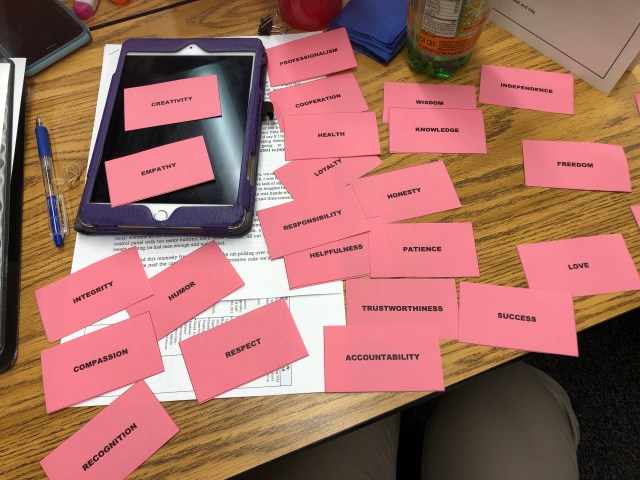
We began with a large stack of words on individual cards. Holly asked us to do a quick sort of the words. I knew we were heading to selecting our top values, and it would be a fast process, so I sorted with that in mind. Other participants who hadn’t experienced this before were much slower to sort in the first round.

kpMXMDPER9yDiMa8Nks3jA

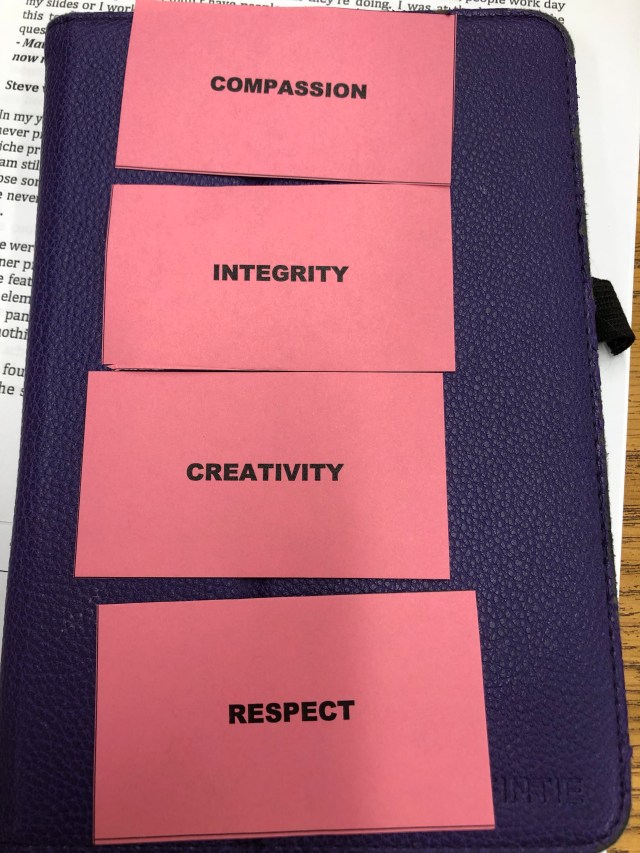
With each round, Holly asked us to get rid of 10 cards. We sorted and sorted until she asked us to find our top four values.  This time these were my top values:

i5e3pT0K%XHpVq1uFOA

Compassion replaced empathy from my previous list of core values, mostly based on my recent rereading of Onward, which is the focus of my monthly blog series.

Creativity and integrity were on my previous list and they remained.

Equity was on my list last year, as a written add-on. Holly didn’t give us that option this year. If I had a choice I would have written in equity and collaboration, both of which are important in my life and were missing from this set of value cards.

Respect showed up this year as more important than so many other words. This has always been important to me, but sometimes you don’t know you need it front and center until you feel it is missing in some way.

I encourage all leaders to go through the process of determining what your core values are. I appreciate repeating this process every year, as a way to reflect on how I’ve changed and grown.

What are your core values?

Posted in Reflection | Tagged , , , , , , | 2 Comments

Shine 2019 Update #1

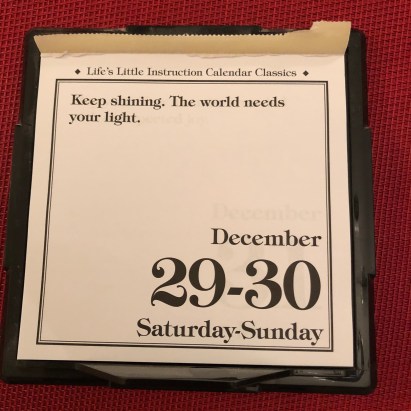
My focus word for the year is SHINE. I like to pause and reflect on my word, how it has shown itself to me, and what I’ve done to cultivate the idea within my life. Before I had even announced my word for this year, it was already advising me, back in 2018. On my Life’s Little Instruction calendar on December 29, 2018, the following advice appeared:

Shine advice

I created a Pinterest board to focus on my SHINE this year. There are so many different ways to interpret the idea of SHINE, and each pin takes a different perspective.

SHINE 2019

While I was enjoying a relaxing vacation at the beginning of January, SHINE was evidence as I watched the sun reflected on the water of both the pool and the Sea of Cortez. Sitting on my balcony I felt that I could look at that shining water forever! This view always brings me peace of mind, body, and soul.

shining sun

I look forward to seeing how SHINE shows up for me in the coming weeks.

Posted in Reflection | Tagged , | 1 Comment

January Reading Update

For the last few years, I have published a blog post every month, listing what I read in the month. At the end of the last three years, I published my full list of books read (2018 2017   2016). I enjoy looking back at these posts as a reminder of what I’ve read and enjoyed, and to see what I’m gravitating towards as a reader. My 2018 list was full of mysteries, and sorely lack in YA. I hope to balance that a little more this year, with more YA and more books by authors from a variety of racial and ethnic backgrounds.

This month included a 5 day vacation for me, so I was able to read a lot early on. I read more this month that I did in any one month last year.

  • Killer Heat by Linda Fairstein – A new mystery author I discovered via my Library app – I love finding new authors! Unfortunately, this was a book in a series and I didn’t start at the beginning, so it was confusing at times. I liked the idea that the main character was a female D.A. who worked directly with NYC police detectives to solve crimes. I plan to research the series so I read more.
  • The Path to Serendipity: Discover the Gifts Along Live’s Journey by Allyson Apsey – This is a professional book I’ve wanted to read for awhile. It’s one of the book options for the district book study I coordinate and this is part of the “educator self care” themed book study. I appreciated the author’s honest storytelling, vulnerability, and eternal optimism. She lays out her challenges as well as some advice for living your best life.
  • The Greatest Love Story Ever Told: An Oral History by Megan Mullaly and Nick Offerman [audiobook] – I love both of these actors separately, and only recently learned that they are married. This was a great book to listen to read y the authors, while on vacation. The audiobook literally felt like listening to a married couple perform a one act play and/or have a random mix of conversation – it was so much fun to get to know their lives a bit!
  • Beautiful Lies by Lisa Unger – I discovered this author last month, and I enjoyed the first two books I read by her. This third book was different, and I did not enjoy the narrator (Ridley) who was a clueless, victim protaganist throughout most of the story. I did enjoy some of the twists of the storyline, but it wasn’t my favorite plot or storytelling.
  • The Rainbow Comes and Goes: A Mother and Son on Life, Love, and Loss by Anderson Cooper and Gloria Vanderbilt [audiobook] –  What a beautiful story! I loved listening as this mother and son got to know each other through a series of letters they exchanged after she turned 91. I knew practically nothing about Vanderbilt’s life history, which was sad and fascinating; her son didn’t know many of these details either. I love that these two are closer than ever, after losing Anderson’s father and brother too early in life. The image of the rainbow coming and going in life was a powerful way to end a touching story of family and love.
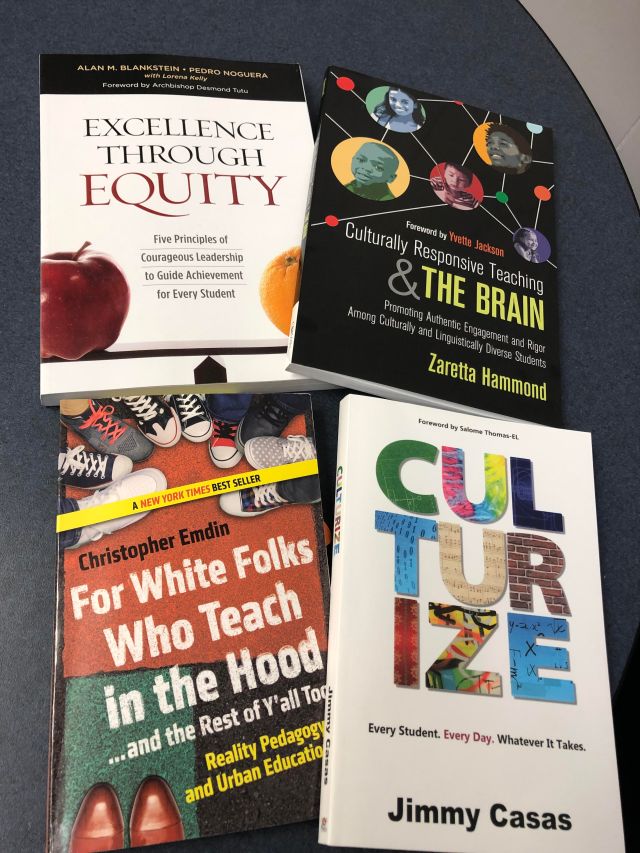
  • For White Folks Who Teach in the Hood… and the Rest of Y’all Too: Reality Pedagogy and Urban Education by Christopher Emdin – This is another book that will be used by the teacher leadership book study that I facilitate in my district. The author spoke to a small group of educators in our district last year, and I am so disappointed that I was unable to attend. Reading this book reminded me so much of my first few years as a young teacher, when I was trying desparately to connect to my students, trying to be “cool” so they would like me and my class. Emdin’s reality pedagogy would have helped me be a better teacher soon. As I read about the seven C’s (cogenerative dialogues, coteaching, cosmopolitanism, context, content, competition, and curation) I recognized piece of what became my own pedagogy in my classroom, but I also recognized significant gaps I could have improved. I always used music that my students enjoyed to connect with them, and to connect them to some content. I never did anything that involved cogents where I brought together a small group of students to give me feedback on teaching and learning in my room, nor did I ever take the coteaching idea beyond the times students did group presentations on small topics within our content. There is so much more I wish I had done for my students, to connect with them and to help them connect to the content. This is a powerful read for all educators who work in urban education.
  • Love, Hate & Other Filters by Samira Ahmed – This year I want to read more YA books and books by authors of color; this book checks both of those boxes. What a bittersweet coming of age story for young Maya, an Indian-American teenager wrestling with her family’s expectations, her personal dreams, and the realities of racism in America. I appreciated the silly teen drama side as well as the serious racial implications of being a Muslim in post- 9/11 America.
  • Darius the Great is Not Okay by Adib Khorram – What a beautiful story! This is another YA, introducing me to another culture very unknown to me. Darius is a teenage Persian whose family goes to Iran to visit his family, whom he has never met before. As he struggles with depression and general teen angst, he finds a friend, gets to know his family, and finds a way back to a relationship with his father, who also struggles with depression. I learned a lot about Persian culture and I appreciated the way the author addressed depression in a realistic way.
  • Culturally Responsive Teaching & The Brain: Promoting Authentic Engagement and Rigor Among Culturally and Linguistically Diverse Students by Zaretta Hammond – This is another book option in my district’s January book club, focused on culture and equity. Having recently read Emdin’s book for the same book club, I found a number of connections between Emdin’s focus on “neoindigenous students” and Hammond’s “dependent learners”. Both argue for a systematic approach to teaching with a cultural frame of reference. Hammond introduces her four part Ready for Rigor Framework, and takes you through each element. She quotes a lot of research and big theories, but is not as prolific on direct strategies. I appreciated the refresher on how our brain functions, how we built long-term memory, and the implications for the classroom.
  • Dare to Lead: Brave Work. Tough Conversations. Whole Hearts. by Brene Brown [audiobook] – What a powerful book! I think all leaders and all humans, would benefit from reading/listening to this book.  Brown’s research on vulnerability leads to so many recommendations for building positive relationships at home and at work. I appreciate so much about this book, and the resources that are available on her website.  There was a section talking about the “stories we tell ourselves” that really resonated with me.  When we jump to conclusions and assume things about others, we are telling a story that impacts our emotions without facts to back them up.  By being honest and able to say to someone, “The story I’m telling myself is that you think I’m a bad leader and a bad person because X went wrong,” we open up the opportunity for real dialogue.  She talks so much about recognizing and naming our emotions, something that many of us are weak in. This reminds me of my desire to spend this year studying Aguilar’s Onward to build habits in emotional resilience.
  • The Alice Network by Kate Quinn – I loved this book! It wasn’t until I read the afterword notes that I learned how much of it was loosely based on historical facts about the women spies of WWI. I enjoyed how the story was narrated by two different women, Eve and Charlotte, and it flipped from the past to the present, as both women discovered themselves as they navigated through life challenges. This was a great historical fiction novel that had me intrigued throughout the entire story!
  • An Unwanted Guest by Shari Lapena – This was a quick mystery read from the library – a group of stranger arrive at a cute inn for a disconnected winter weekend, only to find a brutal storm that knocks out the power. Then, a guest is murdered. Everyone is on edge as they try to figure out what is happening, distrusting and suspecting each other as more people are killed.  It was a fun whodunit!
equity books

The Culture & Equity books for my district book study this month

Posted in Reflection | Tagged , | Leave a comment

Blog Word Cloud 2019

What matters to you? How is that visible to others? How do you communicate your most important values and beliefs?

In the past, I have generated a word cloud from my blog’s URL to see what words I use most often. I find this activity is a great way to see if my writing aligns with my core values, my beliefs, and what I hold most important to me.  In a word cloud, the words that appear larger are words that are used more frequently. I like to reflect on what words jump out to me as I look at a new word cloud.


blog word cloud 2019 jan

Blog Word Cloud January 2019

I love that reflection and reflections stand out to me in my first look. I am so happy to see my word of 2019, SHINE, sitting right in the bottom center. As I stare at this a bit, I see my word from last year, possibility, and I see Aguilar and resilience pop out.  Since my blog is all about leadership and learning and reflection, it’s important to me to see those words. Knowing the purpose of education, seeing students in the center keeps me grounded and focused. Words like book, reading, audiobook, and writing remind me of my personal hobbies and habits, and where I push myself to learn and grow.

I appreciate that this current look into my the words I use most often in my blog resonate with me.

Past posts with word clouds: 

Word Cloud Fun

Key Words

Most Used Phrases

Posted in Reflection | Tagged , , , , , , , , | Leave a comment

Building Resilience: January

This month I begin a deep dive in Elena Aguilar’s Onward: Cultivating Emotional Resilience in Educators and the accompanying workbook. I hope to share some of my reflections as I build daily habits to strength my own resilience and support that growth in others. Aguilar outlines a habit and a disposition for each month of the year. Follow along as I reflect on each month’s key ideas.

January’s habit is to cultivate compassion and the disposition is perspective.Building Resilience

I appreciate that Aguilar begins this chapter by asking us to picture someone for whom we would like to have more compassion. She asks us to keep this person in mind as we read. This reminds me of the value of presuming positive intent. We are all doing the best we can with what we know right now. When we know more/better, we do more/better. The more we can remember this during our interactions, especially the more challenging ones, the better our relationships can be with others.

“Compassion is empathy in action” (Aguilar, p. 199)

This is an important reminder for me. I think I am pretty good at sympathizing and empathizing with people, but that doesn’t mean that I take action to be compassionate towards them, to ease their suffering. I do this with close friends and family members, but not nearly as much with work colleagues.

Some of the advice Aguilar offers in the workbook for January is to reflect on the past year and set resolutions or a word for 2019.  I’ve already done that work and my word for the year is SHINE. Two simple exercises from the book and the workbook are a compassion practice and a loving kindness meditation. It is amazing to me that the simple act of closing my eyes and saying a few simple phrases (such as “May you be free from suffering” or “May I be at ease”) can relax my entire body and mind. I have been inconsistent with my mediation practice in the last few months, but this is a reminder that even a short minute or two can provide comfort. This month I set reminders in my calendar to do this throughout the work day. When the reminder popped up, I took a moment to repeat some of her recommended phrases. This really helped me keep compassion in my mind at work and throughout the day.

“Compassion for others must begin with self-compassion. You cannot have true compassion for others if you do not have it for yourself” (Aguilar, p. 206)

I don’t know about you, but this is something I struggle with a lot. I find it easier to have compassion for others than for myself. I would never talk to a friend or colleague the way I talk to myself when I am stressed out, angry, or upset. This is an area in which I truly want to build better habits. In the workbook Aguilar suggests writing a self-compassion letter, which I did. This exercise helped me put to words some areas where I have been less compassionate with myself than I would like. Moving from that into some journaling on cynicism allowed me to reflect on areas where I have been less compassionate with others than I would like.

Have you ever wondered how therapists live a normal life outside of their sessions, not taking on the stress of their clients? I love Aguilar’s perspective on empathic distress and compassion fatigue, that many servant leaders face. I remember this feeling, without knowing what to call it, as a new teacher, where I was so stressed out about my students’ home lives, lack of food, experience with violence, and other troubling situations, that I couldn’t sleep. I took this on again as a new administrator, constantly replaying conversations through my mind all night long, again making it hard to sleep. Now I realize I was suffering from compassion fatigue, taking on others’ suffering myself. In the workbook Aguilar recommends we draw a picture of our self in conversation with someone who consumes us with their suffering. When we are talking to this person, we are to picture our self in a bubble, and to picture the other person in their own separate bubble. We can still see and hear everything, but our bubble provides a kind of detachment that gives us emotional space.

When I think about cultivating compassion and perspective, I believe there is a lot I can do to be more compassionate with others. When I “zoom out” and look at an issue from a new perspective, I can go beyond sympathy or empathy and take action to show compassion. This is definitely a work in progress for me, and I will continue to reflect in my personal journal, going back to some of the activities provided by Aguilar in the book and the workbook for this month’s habit.

I’ll see you next month – February’s habit is to be a learner and the disposition is curiosity.

How are you cultivating compassion in your personal and professional life? If you read Chapter 8 this month, please share in the comments some of your reflections. 


Posted in Reflection | Tagged , , , , , , | 3 Comments

Learning to Lead: A Self-Reflective Survey

I’ve read the book Learning Leadership by Kouzes and Posner twice now – once on my own and again as part of a book study with all the principals in my district. With each new reading, I take away a new idea or a new leadership move.

“Learning to lead is about discovering what you value, what inspires you, what challenges you, what gives you energy, and what encourages you.” ~ Kouzes & Posner (p. 36), Learning Leadership: The Five Fundamentals of Becoming an Exemplary Leader

learning leadership

In the book, the authors spend time encouraging leaders to reflect on themselves, and their own values.  I have blogged about my core values a number of times, but I wanted to take it a step farther and answer all of the questions below, from the book. Please feel free to join me by posting your own answers in the comments or on your own blog.

What do I value?

As an educational leader, I value honesty, integrity, transparency, and equity. I value a student-centered approach to decision-making that honors the hard work educators do every day on behalf of students. I value open communication and active listening skills.

What inspires me?

Seeing students excited about learning inspires me.

Seeing teachers excited about teaching and learning inspires me.

Seeing leaders engaging with students, staff, and community in positive ways inspires me.

What challenges me?

I am challenged by an education system that by its design and original intention created inequitable practices that unintentionally harm students.

I am challenged by beliefs that appear to me to be more adult-centered than student-centered.

I am challenged by educators who seem to have given up on students, in the face of overwhelming frustration.

What gives me energy?

Hard-working people who love their jobs give me energy.

Helping a new leader have their own a-ha moment gives me energy.

Hearing students using academic language in authentic and meaningful ways gives me energy.

Empowering educators to give students voice and choice in their learning gives me energy.

What encourages me?

All of the new teachers who continue to enter this profession on behalf of students encourage me.

All of the new leaders who have made a choice to impact adults and communities in addition to students encourage me.

All of the educational leaders who advocate for public education at the local, state, and federal level encourage me.


How about you? 


Posted in Leadership | Tagged , , , , , , , | 1 Comment

Introducing A New Blog Series

As 2019 begins, I’ve decided to challenge myself with a new blog series. I read Onward: Cultivating Emotional Resilience in Educators by Elena Aguilar (my educational spirit animal!) midway through last year. I loved it, as I’ve loved all of her professional books, but I realized that a deeper study of the work could benefit my own emotional resilience as well as others. I’ve decided to reread the book and use the accompanying workbook to reflect; I will dedicate a blog post to share some of my reflection each month.

In this series, I will focus on the monthly habit and disposition outlined by Aguilar throughout the book, going January through December.  I would love it if you would join me in this journey. If you haven’t yet read this amazing and support book, you have a chance to purchase a copy for yourself before my blog series begins. We could consider this our own virtual book club, as we support one another in cultivating our own emotional resilience as educators. As Aguilar writes, “the opportunity for resilience originates in how we make sense of the things that happen, because interpretation dictates actions”. I plan to use this blog series to build the skills that help interpret stressful situations in the heat of the moment.

This reminds me a lot of my year focused on mindfulness.  In fact, reading Onward the first time made me think about mindfulness quite a bit. I hope this blog series will help remind me to be present, in the moment, of life, and to shine a light on my professional growth.

I reread the Introduction as I wrote this first post. From the beginning, Aguilar defines resilience as a way of being, and something that we can grow through daily practice. She sets the stage for the importance of this, given how stressful daily life as an educator can be. We want to move away from toxic stress and into healthy stress; the statistics of teacher turnover in the U.S. are staggering. As a leader, I want to help other educators do more than survive stress, I want them to thrive as they work towards educational equity for all students. If we want to engender resilience in our students, we must ensure that the adults who work with the students are resilience themselves. I appreciate that Aguilar breaks down the work into three overlapping areas:

  • individual resilience
  • organizational conditions
  • systemic conditions

In the Onward workbook, Aguilar begins with journaling, drawing, and collecting ideas as we prepare to build habits to help us build our resilience. I am a journaler by nature; I reflect best by writing. I am also a collector, of ideas more than of stuff, which aligns with one of my top strengths, Input. I look forward to using the ideas presented in the workbook to prepare for this journey.

Building Resilience

Next up in the series:

  • January – Habit: Cultivate Compassion; Disposition: Perspective


Posted in Reflection | Tagged , , , , , , , | 7 Comments

My Word of 2019

Happy New Year! It’s hard to believe that it’s 2019 already. Just as I have for the last four years, I have selected a focus word for the year. This is different from setting new year’s resolutions. I choose to find a word that represents what I want, need, and hope 2019 will bring into my life, but sometimes the word chooses me. Before I share my new word with you, let’s look back on my last few words.

In 2018, my word was POSSIBILITY with a supporting phrase of Adventures that Stretch. This idea helped me looked differently at what was possible if I shifted my viewpoint. I also enjoyed some incredible adventures that did help me stretch in new ways.

For 2017, my word was CHALLENGE, and it served me personally, professionally, and on a global scale. I love new challenges and appreciated the permission I gave myself to rise to some new challenges and to say, “I’m not going to take this on,” to other challenges.

In 2016, my word was REJUVENATE, with a more internal, physical focus that I needed.

The first time I chose a focus word was 2015, and my word was MINDFULNESS. This proved to be a fulfilling year of learning to be more present, learning to mediate, and to enjoy each individual moment.

My word of 2019 is… SHINE.

Copy of Follow your dreams

There are many ideas that SHINE brings to mind.

  • I would like to SHINE in my work.
  • I would like to SHINE a light on the good work done by and for others.
  • I would like to SHINE as a happy, grounded person.
  • I would like to SHINE as a healthy human.

Have you chosen a word, a goal, or an intention for 2019? Please share!


Posted in Reflection | Tagged , , , , , | 10 Comments

What I Read in 2018

When I was an English teacher I used to keep a list of the books I read on my classroom door. I read a lot of Young Adolescent books so I could always make a recommendation for my students. During those years, I also kept a reading journal, writing about what I read and my thoughts.

Now, I keep lists of what I read for my own benefit, on my blog.  I love being able to search my blog to remember a certain book, to find out where I left off in a series (like that of the Jack Reacher series by Lee Child or the Stone Barrington series by Stuart Woods), or just to compete with myself to read more books than I did the previous year.

I must admit that I am a little disappointed that I didn’t read as much this year as I did last year or the year before. I had a few reading slumps this year, I listened to A LOT of podcasts in place of audio books, and I reread excerpts of a number of professional books at work, but none of that added to this list. There were months that I also watched too much TV, so I made a concerted effort to change that habit into more reading.

Looking through my list, it seems that I read more mysteries than anything else – by my favorite authors and new-to-me authors as well. I read very little YA this year, but I did continue to enjoy celebrity autobiographies. There aren’t a lot of professional books on here, but I do have a stack of new professionals books I hope to read in early 2019. There are some books on this list that I have absolutely NO memory of, which is why this blog is as much for my memory as anything else.  But there are others, like The Immortalists that I can still remember in great detail.

If you’ve read my monthly reading updates, thanks for playing along.  If you know of any books you think I would enjoy, please let me know.

2017: 59

2016: 69

2015: 44

What I read in 2018:

  1. Promise My Love (The Bradens Book 7) by Melissa Foster
  2. After You Left by Carol Mason
  3. Culturize: Every Student. Every Day. Whatever it Takes. by Jimmy Casas
  4. We are Going to Need More Wine by Gabrielle Union (audiobook)
  5. Final Girls by Riley Sager
  6. A Leader’s Legacy by Kouzes & Posner
  7. Paris Match (Stone Barrington #31) by Stuart Woods
  8. The Woman in the Window by A.J. Finn
  9. The Memory Watcher by Minka Kent
  10. Lead Like a Pirate: Make School Amazing for Your Students and Staff by Shelley Burgess and Beth Houf
  11. Insatiable Appetites (Stone Barrington #32) by Stuart Woods
  12. What Happened by Hillary Rodham Clinton
  13. The Hate You Give by Angie Thomas
  14. Future Home of the Living God by Louise Erdrich
  15. In the Midst of Winter by Isabel Allende
  16. Salvage the Bones by Jesmyn Ward
  17. Rules of the Game: How to Win a Job in Educational Leadership by Marilou Ryder
  18. The Memory of Light by Francisco X. Stork
  19. Hot Pursuit (Stone Barrington #33) by Stuart Woods
  20. The Good Liar by Catherine McKenzie
  21. Missing You by Harlan Coben
  22. Stories I Only Tell My Friends by Rob Lowe (audiobook)
  23. The Kidney Hypothetical or How to Ruin Your Life in Seven Days by Lisa Yee
  24. Foreign Affairs (Stone Barrington #35) by Stuart Woods
  25. Kill the Boy Band by Goldy Moldavsky
  26. The Fix Up by Kendall Ryan
  27. Same Beach, Next Year by Dorothea Benton Frank
  28. Onward: Cultivating Emotional Resilience in Educators by Elena Aguilar
  29. Pretty Mess by Erika Jayne (audiobook)
  30. The Color of Water: A Black Man’s Tribute to His White Mother by James McBride
  31. Retire Inspired: It’s Not an Age, it’s a Financial Number by Chris Hogan (audiobook)
  32. Scandalous Behavior (Stone Barrington #36) by Stuart Woods
  33. Talk to Me: Find the Right Words to Inspire, Encourage, and Get Things Done – Six Principles of Effective Communication by Kim Bearden
  34. Educated by Tara Westover
  35. Family Jewels (Stone Barrington #37) by Stuart Woods
  36. The Immortalists by Chloe Benjamin
  37. Dishonorable Intentions (Stone Barrington #38) by Stuart Woods
  38. The Silent Sister by Diane Chamberlain
  39. The Bay at Midnight by Diane Chamberlain
  40. The Thousandth Floor (Series #1) by Katharine McGee
  41. Sex, Lies, & Serious Money (Stone Barrington #39) by Stuart Woods
  42. This Will Only Hurt a Little by Busy Philipps (audiobook)
  43. The Midnight Line (Reacher #22) by Lee Child
  44. This is Me: Loving the Person You are Today by Chrissy Metz (audiobook)
  45. Thyroid Healing by Anthony William
  46. Medical Medium: Secrets Behind Chronic and Mystery Illness and How to Finally Heal by Anthony William
  47. Run by Kody Keplinger
  48. Then She Was Gone by Lisa Jewell
  49. Below the Belt (Stone Barrington #40) by Stuart Woods
  50. I am Watching You by Teresa Driscoll
  51. Say You’re Sorry by Melinda Leigh*
  52. Dead End Girl by Lt. Vargas and Tim McBain
  53. Becoming by Michelle Obama (audiobook)
  54. Heartbroken by Lisa Unger
  55. Fragile by Lisa Unger

*I blogged about my reading each month from January through November, but I’ve simply added my December reads to this list, since this will be published when I would normally publish my monthly reads. In December I found free books in two ways: I finally updated my public library card to use their e-reader app and through Amazon Prime. I LOVED listening to Michelle Obama read the audio version of her amazing book!

Posted in Reflection | Tagged , , , , | 1 Comment