Tell Me More

I just finished listening to the audiobook version of Brene Brown’s Braving the Wilderness and I’m still thinking about an idea that she discussed related to conflict.  In her book, Brown cites conflict research by Dr. Michelle Buck. Buck uses the term “conflict transformation,” saying that it is about “creating deeper understanding” that requires “perspective-taking.” This is different from our typical view of conflict resolution – where one person usually wins or both people feel like they lose a little when they find a compromise. 

The idea of conflict transformation includes rethinking conflict as a way to get to know someone’s perspective on a deeper level.  When most of us are in the center of a conflict, our fight or flight instincts kick in and we either prepare to stand our grand and fight or we run away from the conflict. Buck’s research advises us to transform a conflict by saying one simple phrase… “tell me more.”

By asking someone to tell you more, you will learn their perspective, why they believe what they believe, and it might often help you come to a more natural place in your conflict. It also allows you get to know the person on a deeper level.

I use the phrase “tell me more” or “say more about that” in coaching conversations. Coaching is often about listening closely, and once you get someone talking, you want them to keep talking.  When we talk, we often solve our own problems, realize our own mistakes, and discover new ideas within ourselves. If I am in a coaching conversation with a teacher or a new administrator, I begin with an open-ended, reflective question. This usually provides the space for my coachee to open up about his practice. But after he feels he has answered the question, he will often look to me to for confirmation. Instead of adding my own thoughts, this is the perfect time to say, “say more about that”. This simple phrase gives my coachee permission to keep talking, keep reflecting, and to address his own challenges.

Whether in a conflict or a coaching conversation, I encourage you to use the phrase “tell me more” to provide someone the open space they need. You will both benefit!

Posted in Reflection | Tagged , , , , | 1 Comment

The Value of Reflection

While reflection might not seem like a relevant topic for my Time Management for Leaders series, stay with me for a moment!

One of the ways in which leaders often lose time, or get sidetracked, is when everything is done at the last-minute, forcing you to make split-second decisions.  Some of these decisions end up being the wrong ones, which then causes a leader to have to backtrack, apologize, fix problems, or spin their wheels.

When we take time to pause and reflect, we give ourselves time in the future. A simple dictionary definition of reflection is “serious thought or consideration”. I know that when I take the time to thoughtfully consider something now, it saves me time (in mistakes, errors in judgment, or just feeling rushed) later.

In a not-work-specific example, I am currently reflecting on what my word for 2018 might be. Each year around this time, I begin a journaling activity designed to help me select a word that will represent the coming year. Knowing that this word will be a focus for 365 days, I take the process seriously and I don’t rush to pick the first word that comes to mind. For anyone interested in this task, I use the materials created and provide by Susannah Conway. I want to select a word that will help provide me direction both personally and professionally.  My previous words have been:

  • 2015- Mindfulness
  • 2016- Rejuvenate
  • 2017- Challenge

Bringing us back to the topic of Time Management for Leaders,  I encourage leaders to practice this important phrase:

I’m going to have to think about that and get back to you.

This is something I learned to say as a Principal, when it felt like people were constantly coming to you, expecting immediate decisions, about 150 times a day. Some decisions are easy and can be made in the moment. Other decisions should never be made without serious thought and consideration. A leader needs to distinguish between the two, and learn to take time for reflection when it matters.

For more thoughts on how leaders can built-in reflection as a habit, from A to Z, feel free to visit my Abecedary of Reflection.  I’d love to hear your thoughts and ideas about reflection in the comments. And stay tuned for what my word of 2018 will be!

wordcloud

Time Management for Leaders Series

Calendar 911

No More Inbox Ailment

Making Time for Classroom Visits

Organizing Resources to Share

Working with an Assistant

Taking Time to Build or Strengthen Relationships

Good Leaders Don’t Do It All Alone


Posted in Leadership, Reflection | Tagged , , , , , , | Leave a comment

A Year of Challenge

My word of the year is challenge. In January I wrote this about the focus this year:

Here is what challenge means to me and what I hope it will bring in 2017.

  • Professionally, I want to challenge myself to continue to expand my skills and grow as a leader
  • Personally, I want to challenge myself as a writer, to get more focused on writing a book and using my writing as a form of action
  • As a citizen, I feel we will face many challenges in the coming year and I am ready – I feel like these challenges will be a call to action and I’m prepared to take action

In September I reflected on how challenge had manifested itself professionally, personally, and as a citizen. Since that post,

Professionally, I have challenged myself:

  • to serve in a formal mentor capacity.
  • facilitating new experiences, such as our district’s creation of a new mission and belief statements  as well as teacher leadership opportunities.

Personally, I have challenged myself:

  • to slow down! After an unexpected leg injury, I have spent the last month in a walking boot, forced to slow down, ask for help, rely on others, and develop more patience.  This was a big challenge for me, but I feel stronger for having lived it!
  • my book has a few more pages written, and a new outline, but it’s been a challenge to get refocused on that after the injury.

As a citizen, I have challenged myself:

  • to continue to communicate with my government representatives about my beliefs.
  • to take a greater interest in educational advocacy through various organizations.

I continue to appreciated that challenge was the right word for 2017. I haven’t thought about a new word for 2018 yet, but I am looking forward to that process in the coming weeks.

challenge-1

Posted in Reflection | Tagged , , , | 2 Comments

November ’17 Reading Update

This month I read 5 books, bringing my annual total up to 41. My goal was to beat my 2016 record, but that is far away, so my new goal is to just enjoy whatever I read between now and December 31, 2017.

  • The Girl Before by JP Delaney – I saw this book recommended on Julie’s blog and knew I needed to read it. I love stories told from different character’s perspectives, and I love mysteries, and this was a good combination of both.  The chapters were told from the perspective of Emma (past) and Jane (current), two different women who lived in the same house at different times.  The mysteries of the house, the architect, and the women all unfold in bits and pieces and this was such a quick read I finished it on one Sunday. I haven’t done that in a while!
  • Doing Hard Time (Stone Barrington #27) by Stuart Woods – This story was a carryover from the last one, with some Russian mobsters out to get Stone, this time by trying to kill his son. Stone’s son, along with two friends, graduated college and moved to LA to begin their movie-making career. The Russian mobsters make this tricky, as Teddy Fay, former CIA man in hiding, saves the say over and over again!
  • Standup Guy (Stone Barrington #28) by Stuart Woods – While I enjoyed this book, I was surprised by how much of the story was about characters other than Stone and Dino, such as a recently release prisoner with a ton of money to hide and spend. I was surprised by Stone’s stupidity in this one, getting conned a few times by a woman he was attracted to; he doesn’t usually get fooled so easily.
  • Learning Leadership: The Five Fundamentals of Becoming an Exemplary Leader by James M. Kouzes and Barry Z. Posner – I loved The Leadership Challenge by Kouzes and Posner during my doctoral studies, so I was excited to this book by them recently. I found this to be practice advice for new leaders wanting to grow. I appreciated the self-coaching actions with reflective questions at the end of each chapter, and I forced myself to complete many of them in my own leadership journal (which I’ve kept for many years now). I learn well when I take time to reflect on my learning, so this forced me to pause and reflect throughout the reading. The five fundamentals, which are explored in detail in the book, are: believe you can, aspire to excel, challenge yourself, engage support, and practice deliberately.
  • The Rooster Bar by John Grisham – I can’t remember the last Grisham book I read, though I loved them for years and years.  This was a fun read, and different than my usual quick mysteries.  Mark, Todd, and Zola decide to quit law school in their final semester, after coming to the realization that their school was a pay-for-degree program with little success in helping students pass the bar exam and become real lawyers.  Their story is one of twists, turns, and lots of law breaking as they navigate their way through crushing student loans, deportation, and a friend’s suicide.  I found myself routing for them to succeed, even as they broke law after law for their own benefit.  It was an interesting story!
Posted in Reflection | Tagged , , , , , | 1 Comment

October ’17 Reading Update

This month I read 4 books, bringing my 2017 total to 36. I’d love to hear what you are reading lately.

  • Balancing Acts by Zoe Fishman – This was a cute, fiction, chic lit book I found on sale for my Nook, and it was the perfect vacation read! Four women meet up at their 10-year college reunion, and strike up a deeper friendship than they had in college, centered around developing a new yoga practice. Each women is in a different phase of relationship and career struggles, and as their friendships blossom, they find clarified in their lives.  It was a sweet story.
  • The Cove by Catherine Coulter – This author is new to me, and this story was one of two that I bought in an e-book package. It is a series and I’m excited to read more and see which characters continue in the series. The Cove is about a young woman, Sally, who escaped an abusive father, a twister husband, and being locked up in a sanitarium, only to find more danger awaiting her when she arrives at her aunt’s quaint town in Oregon. She soon connects with an FBI agent, Quinlan, who was searching for her, but realized he was looking for something bigger. There were a lot of secondary characters, including the bizarre town, and some danger throughout. I enjoyed the story!
  • The Handmaid’s Tale by Margaret Atwood – I listened to the audio version of this book, read by Claire Danes. I haven’t yet watched the TV series based on the book, but I want to now that I know the story. I have always loved a good dystopian novel, though they are usually more in the Young Adult realm. This was eery because it was about adults, because it was written so long ago but reminds me of 1984 and other connections to some modern-day politics, and because it wasn’t exactly what I expected. It was great to hear the story from Offred’s point of view, a handmaid in the middle of this bizarre new world order. The novel gives you hope that the times change or that she escapes, since we are listening to her retell the tales. I appreciate the end chapters, one told by a researcher who found her tapes years later and transcribed them, and one by the author explaining her thought process as she created this vivid world.
  • Break Your Own Rules: How to Change the Patterns of Thinking that Block Women’s Paths to Power by Jill Flynn, Kathryn Heath, and Mary Davis Holt – I received this book at the culmination of Women in Leadership initiative I participated in last year. As part of that initiative, I had a mentor I worked with virtually, I attended the AASA annual conference, and I interacted with the 19 other mentees and 9 other mentors in this national initiative. What I appreciated about this book is how the authors, who are women leaders who coach other women leaders, lay out the mistakes women often make, and then line them up with new rules. These new rules help you change your mindset about your role within your own organization, your career aspirations, and how to achieve your goals. The section on politics really resonated with me, because I’ve always been someone who said, “I don’t do politics”. In reality, we all DO politics. The authors explain very clearly how to get to know the way decisions are made in your organization and how to become a part of that world.

*I also reread most of The Innovator’s Mindset, since I’ve been participating in #IMMOOC.

Posted in Reflection | Leave a comment

Empowered Leaders Empower Learners (#IMMOOC Season 3, Week 4)

I am participating in a Massive Open Online Course (MOOC) with hundreds of other educators across the globe, about The Innovator’s Mindset by George Couros. These are my reflections for Season 3, Week 3 of #IMMOOC, and the prompt:

Relationships and collaboration are crucial to innovation, but what about working in isolation? Where does that come into play?

As I reflected on George’s words, and this prompt, I was thinking about the importance of the relationships between a teacher and his or her principal/ administration. If a teacher wants to take a risk in her classroom, to try to innovate, she needs to know that she has the support of her administration. If a teacher feels she might “get in trouble” if she steps out of the typical box, she will be less willing to even consider taking a risk. And if that is how a teacher feels, how will her students feel about innovation?

Our school leaders need to be empowered in order to empower innovative learning in their school systems.

“Demanding compliance will not effectively prepare learners for being productive citizens today, nor in their future.” ~ p. 103, The Innovator’s Mindset

The quote above jumped out at me, not just about K-12 students, but also about educators. If administrators demand compliance from educators, they will demand compliance of students, and we will perpetuate our current system. If teachers feel supported and empowered to take risks on behalf of student learning, student and adult learners will benefit!

So as I work with and coach administrators, I hope to inspire them to empower teachers, through collaborative, trusting relationships. Taking risks is… risky! I want to create systems where learners feel confident that they are not risky anything life-shattering by trying something new and different. And as I talk about in my video reflection, posted to Twitter earlier today (and linked below), I hope that my young nephews end up in classrooms where they are empowered in their own passion-based learning!

My video reflection on engaged vs empowered learners and my hopes for my 3 & 4-year old nephews! 


Posted in Leadership | Tagged , , , , , , , , | Leave a comment

Good Leaders Don’t Do It All Alone

In my Time Management for Leaders Series I try to share advice for new leaders, leaders in new roles, and leaders who are working to get organized and efficient with their time, in order to serve as instructional leaders. In order to coach like an instructional leader, you need to control your time and not let it control you! You can see the entire series at the end of this post.

Today I want to be transparent about something that might be a secret to new leaders – good leaders don’t do it all alone. You may see a good leader and think:

  • she is always so together!
  • he is so organized!
  • I wish was as efficient as she is!
  • how does he do it all?!?!
  • I could never be as good as she!

The secret is that most of the good leaders you admire have a strong support system behind them. You may not see all of their system, but know that a system is there, supporting each and every strong leader. None of us can do this amazing and challenging work alone.  Here are some of the support systems that you can develop to help you grow as a leader. The stronger your support system, the better you will be able to manage your time.

  • An assistant – I dedicated an entire post in this series to working with an assistant. Please read it here for more details. Your assistant can and should be a huge part of your support system, keeping you organized, on schedule, focused on the work, meeting deadlines, and available for your community.
  • A way to keep notes – Have you ever walked down the hallway, had a teacher ask you something, and by the time you got back to your office you forgot what you needed to do? Every leader needs a way to keep notes, so that deadlines are met, communication happens consistently, and you are known as reliable. I personally use Evernote, because it is an app that I can access on any device at any time. I often only have my phone with me when I am visiting sites. I can take notes in Evernote on my phone and review the notes on my computer when I return to my office.  I know other leaders who carry one notebook with them everywhere. They have color codes and post it notes to help them find their To Do lists and keep track of the notes they keep. Where you keep your notes is only important to you; how you use and access them to follow through is important to those you lead. If you don’t have a system to keep notes yet, ask other leaders what they use.
  • A mentor – Very few leaders have gotten to their positions without the coaching support of a mentor (or a few!). Mentors can provide us with constructive feedback, advice, and support in our current roles and development to help us achieve future goals. I have found it helpful to have mentors in the positions to which I aspire, as well as long-term mentors who have watched me grow as a leader.
  • Job-Alike Peers – Your peers, in job-alike roles, can provide you support in how to do specific tasks, how to handle challenging situations, how to work with a difficult colleague, and they can cover for you when you need to be in two places at once. When I was an Assistant Principal, I worked with number of other AP’s. Having a positive, trusting, working relationship with the other people in your office can help you, as a leader, continue to manage your time and be organized. You can also rely on peers in other schools to help you better understand your role or the day-to-day challenges. Sometimes it is helpful to hear how someone else handles the same situations you face in your role.
  • Family & Friends – I hope that every leader has family and friends he or she can rely on. These are the people you are happy to see at the end of the day, the people who encourage you to take time off during the weekend to play, and the people you want to spend your free time with.  If you work 24/7, you are not making time for family and friends. Your life can be richer thanks to these people.
  • Physical & Mental Health – A good leader knows that in order to take care of others, you must take care of yourself. While many of us struggle to find time for our own physical and mental health, this is important. Part of time management is carving out specific times for you to engage in activities that support your physical and mental health, whether they be trips to the gym, walking dates with friends, meditation, exercise classes, mindful coloring, art classes, or anything else you need.

wordcloud

What else is in your support system? 

Time Management for Leaders Series

Calendar 911

No More Inbox Ailment

Making Time for Classroom Visits

Organizing Resources to Share

Working with an Assistant

Taking Time to Build or Strengthen Relationships


Posted in Leadership | Tagged , , , , , , | 1 Comment

Changes in Practice (#IMMOOC Season 3, Week 3)

I am participating in a Massive Open Online Course (MOOC) with hundreds of other educators across the globe, about The Innovator’s Mindset by George Couros. These are my reflections for Season 3, Week 3 of #IMMOOC, and the prompt:

What is one thing that you used to do in education that you no longer do or believe in? Why the change? 

Over the course of my career, I have changed jobs, schools, and districts, so there are many things that I used to do that I no longer do. Most of those changes are due to the change in my role, as each new position brought new dimensions to my practice.  However, there are a few big ideas that came to mind as I reread Chapters 4 and 5 of The Innovator’s Mindset this week.

I no longer keep ideas to myself. 

Thanks to Twitter, blogging, and being a networked learner and leader, I realize the value and power of sharing my ideas outside of my own office. Even though it can still be scary to hit “publish” on a post and wait to see if anyone reads it, or to think that my thoughts don’t matter much, I take the risk. I recognize that my ideas may be the spark someone else needs to make an innovation a reality in their work.  This video (Obvious to you. Amazing to Others.) illustrates this point perfectly – what is obvious to me may be amazing to someone else. You’ll never know unless you share.

I no longer expect people to ask for permission.

I wrote a post about asking for permission back in 2012. I reread it and added an update in 2016. It is still something I see people struggle with all the time. George writes about the need for trust in relationships so that people can feel free to take risks and innovate. Many years ago, as a principal, I think I expected people to ask my permission if they were going to try something new. I no longer do that and I wish I could go back to my younger self and explain the error of my ways. By trusting our colleagues to be professional, we can open up the doors to innovations that truly impact our students, if we just give it a chance.

I no longer believe that expertise needs to be shared by talking AT people.

Whether I am in a classroom, noticing the balance between student and teacher talk, or in a professional development, noticing the balance between presenter and participant talk, I believe that talking AT people is detrimental to learning. There are many ways to help people learn a new procedure, explore a new topic, or understand a new concept. We can engage learners in reading, viewing, writing, reflecting, discussing, and authentic learning opportunities in order to expand their knowledge. None of these methods require one lone expert to talk AT the learners. I know I was guilty of this as a teacher and as a presenter at professional development, but I work hard now to facilitate interactive learning opportunities for the adults with whom I work. I respect them too much not to.


These are a few of my practices I have changed over my career. I look forward to reading other #IMMOOC reflections about this topic. I’d love to hear in the comments about other practices my readers have changed.

Posted in Reflection | Tagged , , , , , | 2 Comments

Characteristic of My Innovative Mindset (#IMMOOC Season 3, Week 2)

A colleague and mentor recently called me a “path-finder”.  This came in the middle of a discussion about my future career goals and aspirations. When I asked what else I could be doing to further my own leadership development in preparation for future roles, this person said to me, “I’m not worried about you. You are a path-finder. You will find your next role, or you will create it!”

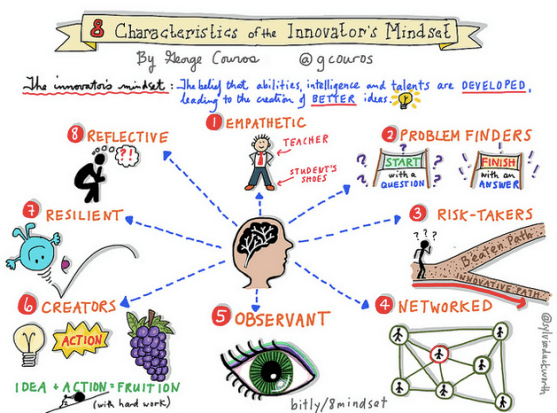
This has stuck with me for a number of reasons, one of which is my rereading of The Innovator’s Mindset by George Couros, and my participation in this Season 3 of IMMOOC. When I reflect about the 8 characteristics of the innovator’s mindset (see graphic below), I believe that I have cultivated many of these as I have grown into my leadership.

8-characteristics-of-the-innovators-mindset

I think the idea of me as a “path-finder” represents my ability to take risks (#3), to be networked (#4), to be observant (#5), to be a creator (#6), to be resilient (#7) and to be reflective (#8). I could probably make a case for characteristics #1 and #2, but I won’t do that… today!

When I began my journey to become a teacher over 24 years ago, I had no idea I would end up where I am (the location or the position!), nor did I have a plan for the path I took to get here. I think this is one of the joys of living a life driven by an innovator’s mindset! I have loved every job I’ve ever had. I have learned ways to improve as a teacher, a coach, a leader, and a learner. I have also learned things that I never want to do as an educator.

There have been times in my career when I decided that my path was going to diverge, because my ethics, my personal beliefs, and my core values, were driving me to make a change. Each time this happened, I really did become a “path-finder,” seeking out an opportunity that would align with my values and allow me the chance to positively impact student or adult learners. My current job was one that didn’t exist before me. I’ve had the honor to create the position and the work over the last two years and it’s been amazing!

I may not exhibit all 8 characteristics of the innovator’s mindset every day, but those characteristics live within me and drive me to make personal and professional decisions regularly. If I never listened to those characteristics whispering to me years ago (long before George labeled them for me!), I might still be in a very different place in my professional life. I am so grateful for the opportunities I have created for myself, as each new experience as helped me grow. My leadership is stronger because of the paths I found and took along my educational journey.

I am participating in a Massive Open Online Course (MOOC) with hundreds of other educators across the globe, about The Innovator’s Mindset by George Couros. These are my reflections for Season 3, Week 2 of #IMMOOC.

Posted in Reflection | Tagged , , , , , , | 1 Comment

September ’17 Reading Update

I’ve been a reading slacker this year!  Because we had a Fall Break this month, my schedule was lighter than normal and I got through a few more books than in previous months. Here is what I read this month.

  • Social Leadia: Moving Students from Digital Citizenship to Digital Leadership by Jennifer Casa-Todd – I am so glad I read this book! This was an incredibly inspiring lesson in the value of social media and the leadership opportunities we provide our students. There are children all over the world who are leaders at a young age, doing amazing things and sharing their gifts through social media. We are not yet taking advantage of these tools in schools as much as we could, for the benefit of student and adult learners. Jennifer’s definition of digital leadership “is the belief that students can use the vast reach of technology (especially the use of social media) to improve the lives, well-being, and circumstances of others”. I have no many notes and pages tagged in my book, from all of the great ideas she shares and the students she introduces throughout the book. One of my biggest takeaways is the recognition that it is our (all of us, educators, parents, citizens) job to teach students the power of positive social media use to benefit others. There are negatives to be aware of, and to help students understand. However, if we avoid the lessons because of our fears, we are not helping students learn for themselves the value of their own digital safety and their digital tatoo. When our students Google themselves, they should have something positive present before they leave high school. We have a long way to go in this area, but I am inspired to get started! I highly recommend this book to every educator and parent!
  • The Best Place to Work: The Art and Science of Creating an Extraordinary Workplace by Ron Friedman – A colleague in HR mentioned this book was one of her absolute favorite professional reads, so I had to add it to my to-be-read list It’s taken a LONG time for me to get to it (and I listened to the audio version*), but I’m glad I finally read it. The author shares various research studies that relate to job satisfaction, workplace friendships, interviewing techniques, and employee appreciation.  I enjoyed hearing how the research highlighted the importance of creating welcoming, open work spaces that provide people freedom to do their work in the way in which they prefer.  *On a separate note, I do NOT recommend you listen to the audio version of this book, as it sounded like it was read by a robot and was not pleasing to listen to during my commute!
  • Collateral Damage (Stone Barrington Series #25) by Stuart Woods – Woods is always my go-to for a quick mystery! After not much reading and some nonfiction, I needed this easy read. I enjoyed that this story was a continuation from #24, with Holly Barker, from the CIA, playing a central role in NYC with Stone Barrington, as they sough Jazmin, the sister of the terrorists who almost blew up LA in #24. I love that Dino and Viv, friends of Stone, were actually the big heroes at the end of this book.
  • Unintended Consequences (Stone Barrington Series #26) by Stuart Woods – After the last book, I had hopes that Stone and Holly would end up in a real relationship. But this book took a very different take, with Stone ending up in Europe with memory loss, chasing missing days and Russian criminals! I love Dino and Viv’s new marriage mixed into Stone’s adventures.
  • Empower: What Happens When Students Own Their Learning by John Spencer and A.J. Juliani – I loved the first book, Launch, by these authors, and I loved this new adventure too! This is a new publishing format that is easy and fun to read, with concrete, real examples of how to empower students to own their own learning.  Similar to The Innovator’s Mindset by George Couros, this is another inspirational read for any educator ready to take student learning to a new level!
  • Conversational Intelligence: How Great Leaders Build Trust and Get Extraordinary Results by Judith E. Glaser – I must confess that I read the majority of this book back in July, but just finally got around to finishing it this month. One of the biggest messages of this book, to me, was about trust. The author describes three levels of Conversational Intelligence. You can only achieve Level III, which is optimal communication, with high levels of trust. She describes a TRUST method that includes: transparency, relationship, understanding, shared success, and testing assumptions and telling the truth.  I found the examples of conversations and group work that succeed or failed very enlightening.

What do you recommend I add to my reading list next? 

Posted in Reflection | Tagged , , , , | Leave a comment