
During the last month I have been on a deep dive into some unlearning and new learning, specifically around Native American history. Truthfully I had very little taught to me about this in school, but I have absorbed a lot of stereotypical and biased information from various media sources throughout my life. Enough of that sunk in that everything new I’ve learned has truly opened my eyes to the misinformation I took in and the things I need to unlearn to remove biased thinking about a huge piece of American history.
I started by taking a variety of digital microcourses on Native Ways of Knowing, offered for free by the San Diego County Office of Education and California Indian Education for All. These courses has been available for a few years, but I finally made time to dedicate myself to this deep learning. The courses I have taken included:
- 7 Essential Understandings for CA Indian History and Culture
- Understanding Land Acknowledgments
- Understanding the American Indian Student in Your Classroom
- Indigenous Voices: Everything You Wanted to Know About Indians But Were Afraid to Ask
- Indigenous Voices of California Missions
- Selecting and Using Educational Materials about Indigenous Peoples – This course was led by Dr. Debbie Reese, of Nambé Pueblo, who has become a leader in representational literature related to Native Americans. I am keeping a list of books she recommends to help our educators.
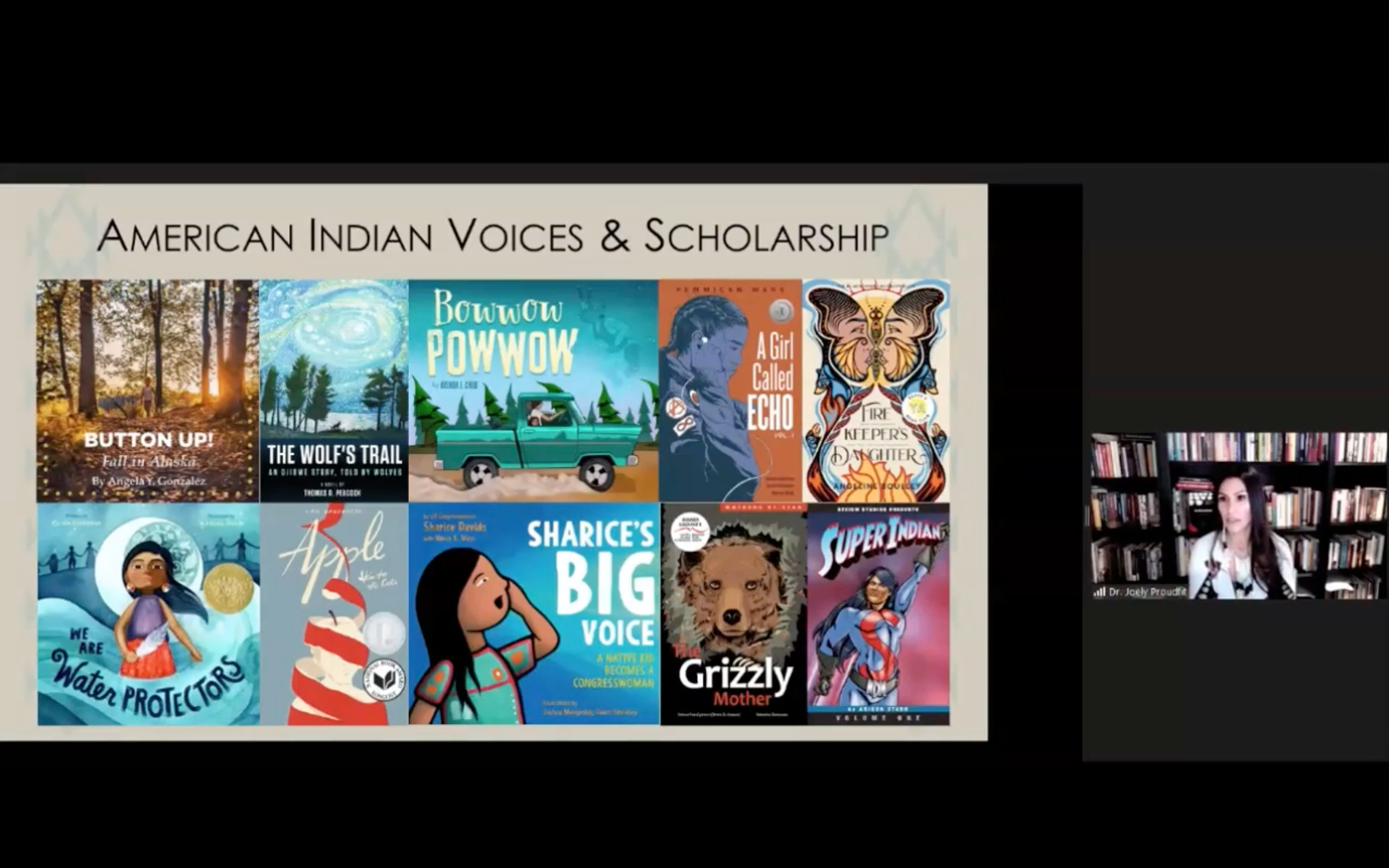
Below is a screenshot from one of the microcourses, featuring Dr. Joely Proudfit and a small selection of recently published books she recommended to teachers to include greater accurate representation in our classroom libraries.
In addition to these courses I have also read the following books this month (or recently) all of which were written by Native Americans:
- An Indigenous Peoples’ History of the United States for Young People by Roxanne Dunbar-Ortiz, adapted by Debbie Reese and Jean Mendoza – A book I will highly encourage all CA 4th grade teachers to read, especially related to the Gold Rush and the CA Missions
- We Are the Land: A History of Native California by Damon B. Akins and William J. Bauer Jr. – A dense historical retelling that was almost 100% new information for me.
- The Birchbark House by Louise Erdrich -A wonderful middle grades book that can be used with students or read by students; I love everything I’ve ever read by Erdrich!
- Project 562: Changing the Way We See Native America by Matika Wilbur -This was recommended to me a few months ago after a colleague heard the author speak at a conference. It is a GORGEOUS book with photographs and one page biographies of every-day humans from tribes and nations all across what is now the USA.
- Notable Native People: 50 Indigenous Leaders, Dreamers, and Changemakers From Past and Present by Adrienne Keene -I’ve had this for a few years, but I brought it back out this month to read more about people who were referenced in some of the new learning I did this month. Each person is described in a one page biography that is student-friendly.
Sadly, so much of what I viewed and read was new information to me. There is so much to learn about the people who inhabited what is now the United States of America before any colonizers or settlers arrived here. Some of my key takeaways include:
- It is always best to refer to people with as much specificity as possible, particularly regarding tribes or nations. There are examples of this on the book list recommended by Dr. Reese above. When those are unknown, the terms Native American or American/California Indian are preferred. If you use the term Indigenous People, be sure to include a location. For example, Indigenous People of Southern California included the Kumeyaay, Luiseño and Cahuilla.
- California has the most Native American students in the entire country. There are 2,456 Native American students in San Diego County in 2024.
- While we want to teach the truth about the brutal history of Native Americans, including the genocide that took place, we must also acknowledge that the Native Americans are a resilient group of people with many different cultures, traditions, languages, and experiences.
- By nature, we want to categorize people, hence terms like Native Americans or Indigenous People. However, these generic groupings erase the individuality of tribes and nations, and their specific cultures.
- When it comes to 4th grade history, teachers must be very careful about how we present information, especially the Gold Rush and the history of the CA Missions. The truth of how the Indigenous People of California were treated as indentured servants or subhuman beings is not covered in traditional textbooks. Just like so much of American history, what was good for one group of people (the Missions were a great Catholic success), was an atrocitiy for others (the Missions were built by the slave labor of Native Californians).
- “Indigenous Peoples’ labor made American California possible” (Akins & Bauer, p. 167)
- There is so much to learn about sovereignty and what that means to people today.
- One of the best things we can do is partner with local tribes and nations in our area to collaborate on accurate storytelling and ensuring that Native American voices are heard and are at the decision-making tables.
- When looking for books and resources to expand our learning and representation, notice the authors and illustrators as well as the characters and storyline. Books about Native Americans written and illustrated by Native Americans are best!
I am so grateful to have these resources available to me for my own learning, and to be able to share these with other educators. This learning must continue and of course there are still more books on my to be read list.

This post is part of a series called Explorations in Instructional Leadership. I plan to use this series to dive into some of the topics that are rising to the surface in my work, topics that I am researching for future study, and topics that impact student learning and pedagogy.

 Reflections on Leadership and Learning
Pingback: July 2024 Reading Update | Reflections on Leadership and Learning
I came across this blog and thank you. I would like to say that roxanne dunbar ortiz is not actually native and i find her very problamatic.